
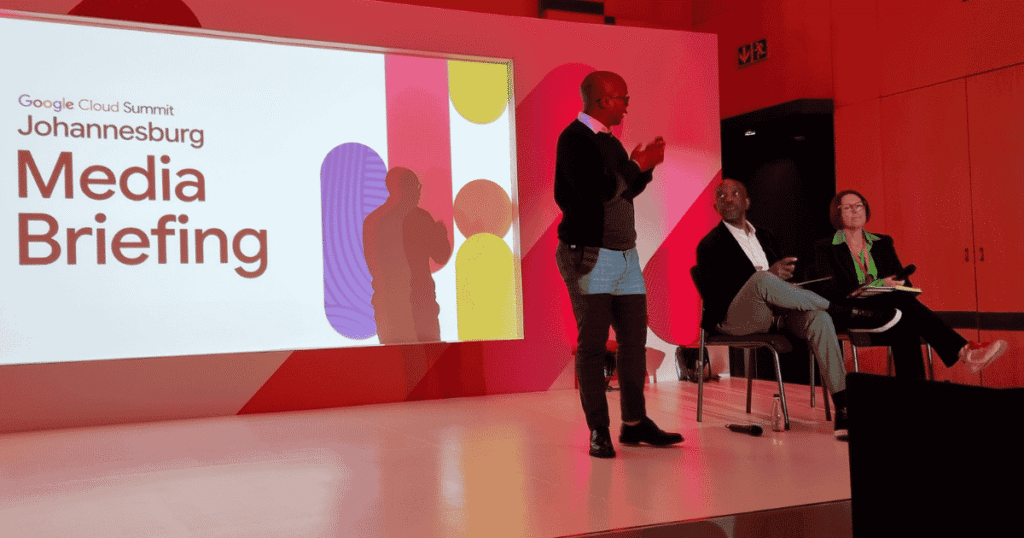
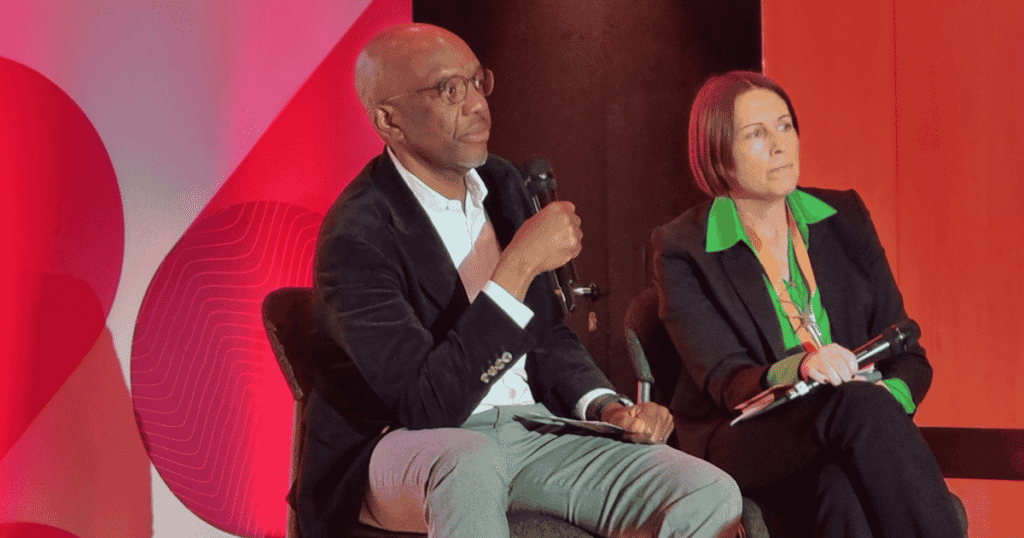
Google’s Senior Vice President for Research, Labs, and Technology, James Manyika, spent about 45 minutes in a room with journalists at Africa’s first Google Cloud Summit. And he was candid in ways that structured settings rarely allow.
Some of it was worth paying attention to.
AlphaFold and the 32,000 African researchers
Manyika mentioned a number that deserves attention.
AlphaFold, Google DeepMind’s Nobel Prize-winning protein structure prediction tool, is freely available to researchers worldwide. Of those researchers, 32,000 are based in Africa. Many are working on specifically African disease challenges. Some are working on drug discovery.
“I can’t wait to see what they’re gonna build,” Manyika said.
That is not a small number. It is also not a number that features in any of the summit’s headline announcements, which is strange, because it is probably the most concrete evidence that the infrastructure Google has already built is generating real scientific activity on the continent.
A South African company called Nexus is already using Google AI models to screen for tuberculosis via chest X-rays. Plant phenotyping tools are being used to develop climate-resistant seeds.
The applied AI lab being launched at the Accra AI Community Centre, which will pair African founders with Google researchers and give them early access to Google’s models, is the institutional bet that more of this kind of work can be accelerated. Applications close 31 August 2026.
The leapfrog argument has a new shape
Maureen Costello, Google Cloud’s VP for the UK, Ireland and Sub-Saharan Africa, made a specific comparison during the briefing that sharpened the broader opportunity being talked about all day.
Africa bypassed landlines and pioneered mobile payments. The continent now has the chance to skip the basic cloud computing conversation entirely and move straight into the agentic era, where AI systems don’t just answer questions but think, reason, and execute complex workflows.
“I looked at all of the keynotes that happened 12 months ago when we launched our data centre here,” Costello said, “and I think the word agentic was maybe used once over the course of that whole day.”
It was used considerably more than once on Wednesday. The shift from experimentation to autonomous action is happening faster than the infrastructure to support it is being built.
The language problem is infrastructure
One of the more substantive exchanges came from a question about what African startups actually said they needed when Manyika and Costello met with them the day before the summit.
The answer was not mentorship. It was also not funding. The top three requests were infrastructure, edge compute, and African language support in AI models.
“We don’t want innovators and creators to be worrying about languages,” Costello said. “We want to give them that as part of the harness that they have.”
Manyika said language support, like connectivity and compute, should be base infrastructure. Founders should not have to build their own multilingual models from scratch any more than they should have to lay their own fibre.
His comment signals that the current state of African language support in Google’s models is not where it needs to be, and that Google knows it. It also explains why the Africa Applied AI Lab is framed around pairing founders with Google researchers rather than simply giving founders access to existing tools. The tools need work too.
On unicorns outside fintech
Arthur Goldstuck from Sunday Times and Gadget Magazine said African unicorns are almost entirely fintech, and asked Manyika if he sees that changing.
“I see all of them,” Manyika said, naming healthcare, agriculture, and education as sectors where he expects significant AI-native companies to emerge. He pointed to Nexus again, and to the plant phenotyping work happening across the continent.
The Google for Startups Accelerator, now in its 10th cohort, has supported over 300 startups across seven African countries since its inception. Startups from the programme have collectively raised as much as $40 billion in subsequent funding rounds, according to Manyika.
The 2026 South African cohort opens for applications on 21 July, with 15 startups selected for equity-free mentorship and funding.
The equity-free part drew an audible reaction in the room. Alex Okosi, Google’s Africa MD, noted with some satisfaction that the startups “seem to like the equity-free part of it.”
Data centres and the environment
The most unscripted moment (and one I appreciated) came from a Bronwyn Marcus from Unfold Durban, who said her readers were afraid of AI, and that local businesses in her area were refusing to publish AI-generated content.
She also raised community concerns about data centres, specifically the language around land and resource extraction. Manyika did not deflect.
“Both things are actually true,” he said, referring to the opportunity and the risks of AI. “We should be straightforward about that.”
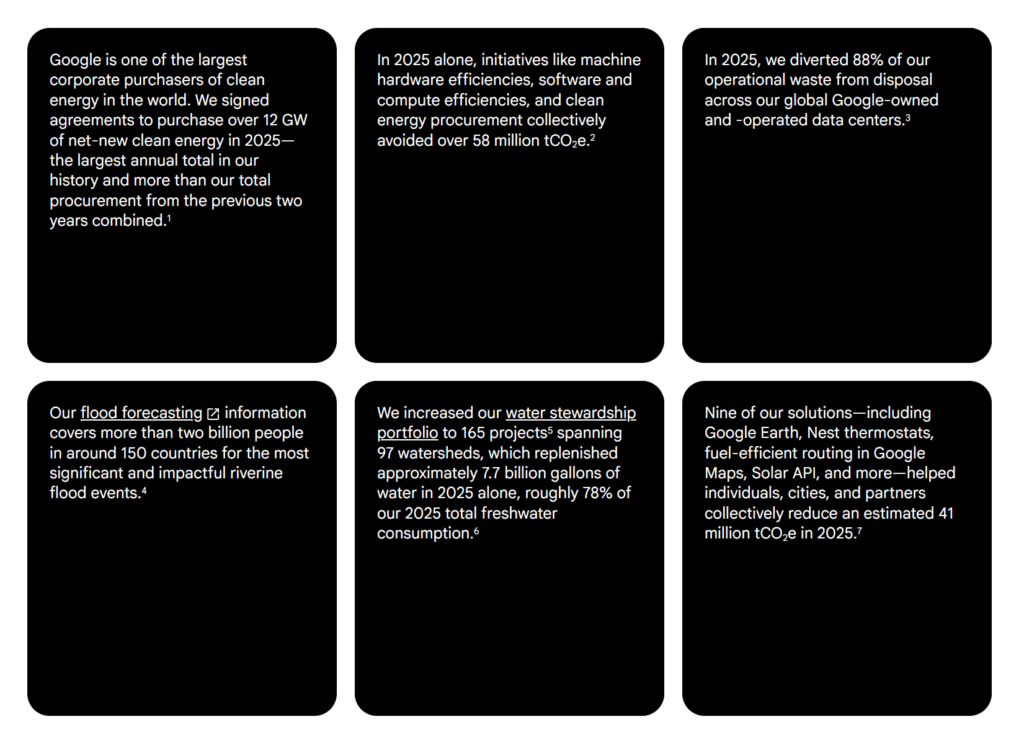
On data centres specifically, he pointed to Google’s 11th annual environmental report, published a day before the summit, which includes commitments to 24/7 carbon-free energy across all data centres and a pledge to replenish 120% of all water used.
READ: The first Google Cloud Summit in Africa came with a warning from Ramaphosa
Google Summit briefing
The summit announcements were structured around five initiatives: a Digital Exchange Port in the Eastern Cape, the Accra Applied AI Lab, a R3 million innovation centre in Soweto, the Akuna Foundation creative partnership, and the 2026 startup accelerator cohort. All five were covered on the main stage.
What the briefing added was texture.
Google is ahead of schedule on its $1 billion Africa commitment, has exceeded it, and keeps investing. The infrastructure being built, subsea cables, cloud regions, connectivity hubs, is the foundation for everything else.
But the candid version of Wednesday’s conversation was that the foundation is not finished, the language gap is real, edge compute is still a problem for founders outside major hubs, and 50% of the continent still lacks reliable electricity.
Manyika said what he was supposed to say, and then he said a few things he did not have to say. Those were the more useful parts.