
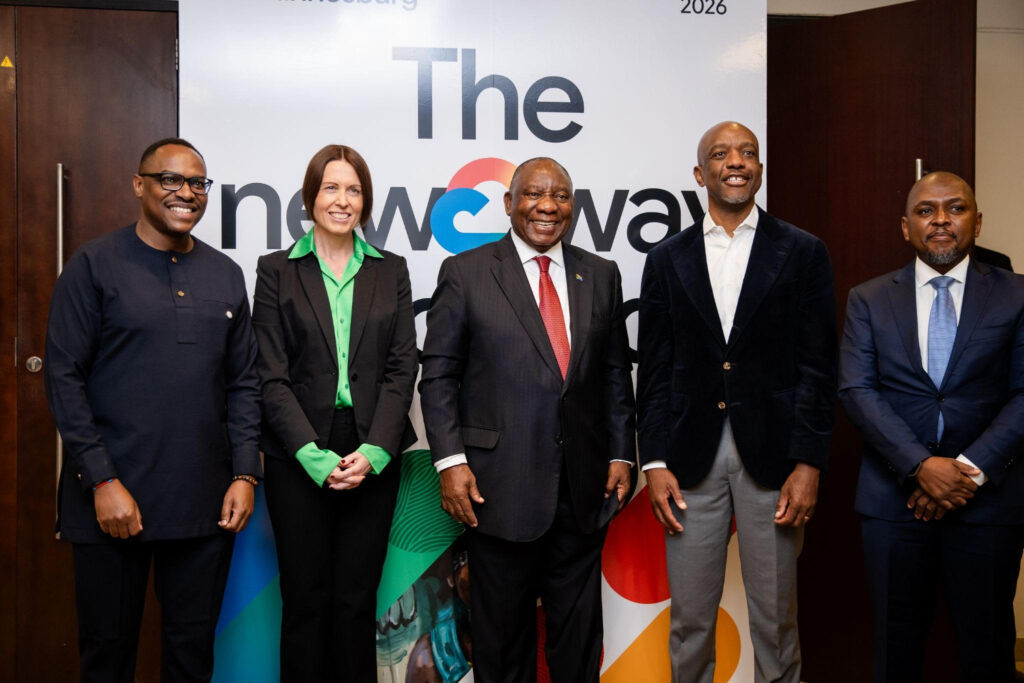
South Africa hosted Google’s first Cloud Summit on African soil on Wednesday, officially opened by President Cyril Ramaphosa. About 3,000 business leaders, developers and public sector officials attended.
Google announced five new investments, and somewhere between the keynote and the press release, a more pointed message came through: Africa is not interested in participating in someone else’s technological future.
Google Cloud Summit 2026: overview
The summit, held at the Sandton Convention Centre under the theme “Building for Africa with Google Cloud,” builds on Google’s 2025 launch of its Johannesburg Cloud Region and the company’s existing $1 billion investment commitment to the continent.
Ramaphosa’s keynote
Ramaphosa spoke about the link between cloud computing and AI, and the infrastructure shifts that shaped previous eras of economic transformation. He placed the AI shift in the same category as railways and electricity.
“Africa intends not merely to participate in that future,” he said. “We intend to help shape it.”
Ramaphosa also raised the question of data sovereignty, calling on Google and other cloud providers “to work with government to build sovereign digital and AI capacity that draws on both state institutions and private sector dynamism.”
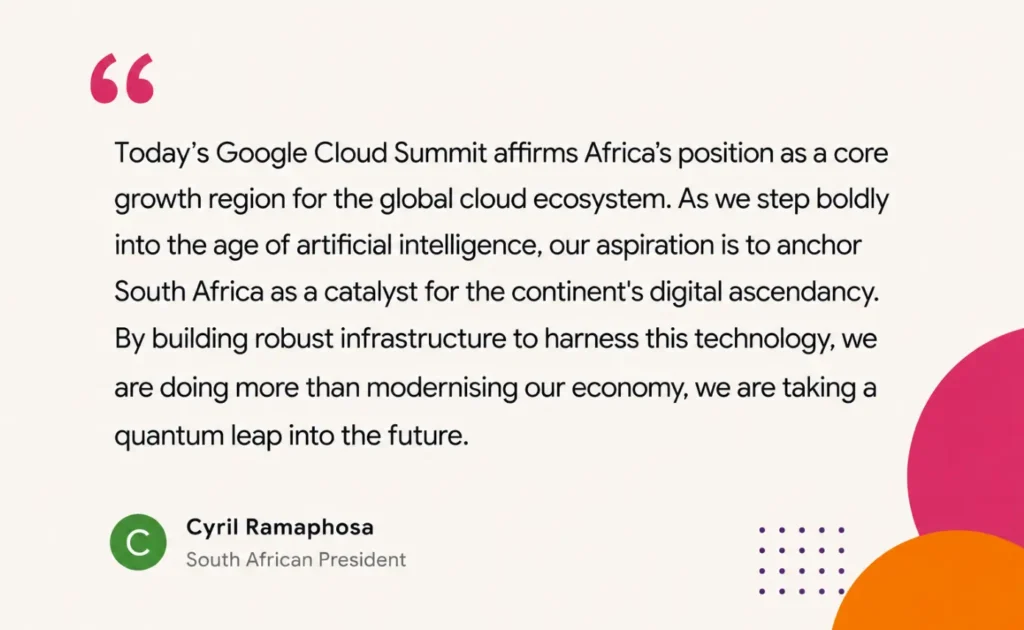
The digital transition, he said, “must be a just one,” and he warned that “we cannot allow digital poverty to widen the gap between the haves and the have-nots.”
Google also used the summit to announce five new initiatives.
Five AI investments
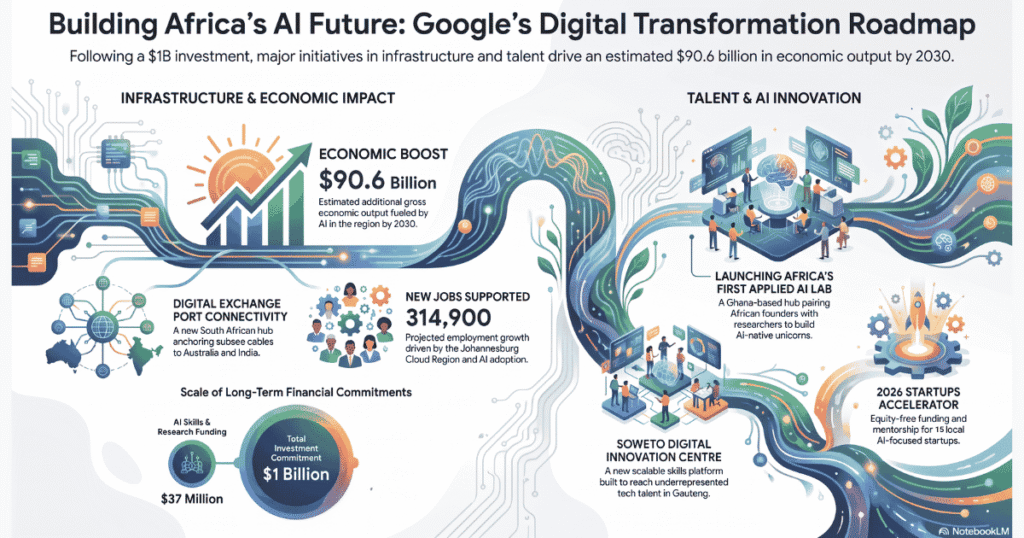
The first is a Digital Exchange Port in the Eastern Cape, the first of four connectivity hubs the company has committed to building across the continent. It will connect South Africa to Australia via the Umoja subsea cable, and to India via a new subsea route.
The second is Africa’s first applied AI lab, based at the Accra AI Community Centre in Ghana. The lab will pair African founders with Google researchers and give them early access to Google’s AI models. Applications close on 31 August 2026.
The third is a partnership with The Akuna Group (founded by Idris Elba). This partnership is backed by more than $1 million in Google.org funding, to deliver AI creative education to underrepresented creators.
The fourth is a R3 million digital innovation centre at the George Tabor Campus of South West Gauteng TVET College in Soweto, built in partnership with WeThinkCode.
The fifth is the 2026 South African cohort of the Google for Startups Accelerator, which opens for applications on 21 July. Fifteen local startups will be selected for mentorship and non-dilutive funding.
ALSO READ: Google Cloud Summit: The off-stage conversation that mattered most
The numbers behind the positioning
South Africa currently hosts about 70% of Africa’s hyperscale data centre capacity, with Cape Town ranking third among African startup ecosystems on the Global Startup Ecosystem Index. Vodacom, Discovery, Pepkor and Naspers are already building and deploying autonomous agents on the Johannesburg Cloud Region.
Maureen Costello, Google Cloud’s vice president for the UK, Ireland and Sub-Saharan Africa, said the Johannesburg Cloud Region is estimated to contribute $90.6 billion (approximately R1.49 trillion) in additional gross economic output and support 314,900 jobs by 2030.
James Manyika, Google’s senior vice president for research, labs, technology and society, described the new investments as targeting “critical areas: infrastructure, African-led innovation, and education and skill building.”
Google in Africa
The fact that Google held this summit here is quite significant. The Johannesburg Cloud Region launched last year. The Accra AI Community Centre opened last year. The subsea cable infrastructure is being built now. These are not announcements about a distant future.
ALSO READ: Google Cloud lands in South Africa: More jobs, more AI, more growth
The physical and digital infrastructure of Africa’s AI economy is being laid at the moment, and the companies doing the laying are making decisions about where it goes, who controls it, and who benefits.
Ramaphosa’s data sovereignty comments are the clearest signal that the South African government is watching those decisions closely.
Participation in a Google Cloud Summit is one thing, but shaping the terms on which that infrastructure operates is something else entirely.