
South African workers are using AI more than most of the world. They’re also saving more time. What’s happening with that time is the more interesting question.
BCG’s fourth annual AI at Work report surveyed 11,749 employees across 14 countries, including 503 in South Africa. The results put SA near the top of the global adoption table, second only to India on time saved, and ahead of the US, France, and Italy on regular AI usage.
That last part should probably embarrass a few people in Silicon Valley.
AI in SA: The numbers
Around 79% of South African frontline employees, meaning individual white-collar workers with no management responsibilities, use AI regularly. The global average is 74%.
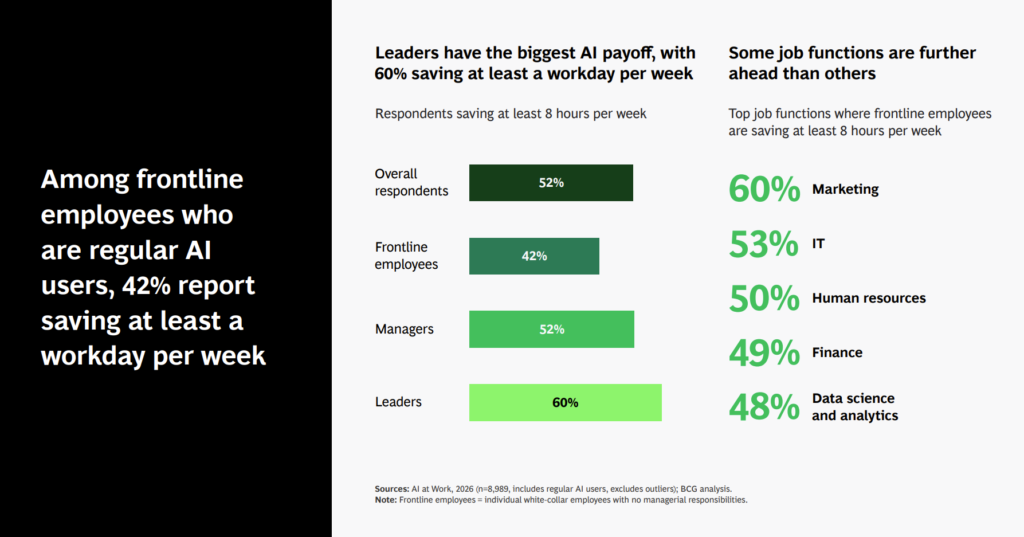
Around 66% of those frontline users report saving at least a full working day per week through AI. Globally, only 42% say the same.
For South African managers and leaders, that figure jumps to 75%, compared to a global average of 56%.
Job satisfaction is also higher locally, at 78% for frontline employees versus 57% globally. Concern about job displacement sits at around 20%, compared to a global average of 36%.
The short version: SA workers are using AI, saving time, and largely not panicking about it.
ALSO READ: Human ego is a bigger threat than AI, says Dr Taddy Blecher
The Joy Paradox
Here’s where the report gets interesting.
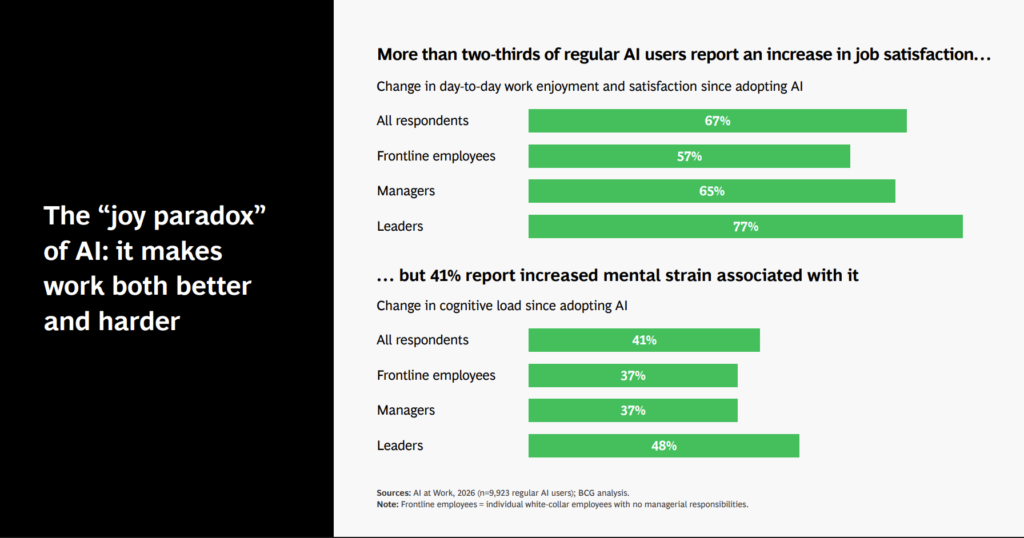
67% of regular AI users globally say AI has improved their job satisfaction.
At the same time, 41% report increased cognitive load. BCG is calling this the “joy paradox”: AI is making work better and harder at the same time.
The honeymoon phase is also real and apparently has an expiry date.
Early users get a boost from novelty and the cognitive stretch of learning something new. That boost fades within about a year if organisations don’t follow up with clear strategy and direction.
ALSO READ: Your security tools found 847 problems. Now what?
The time savings are leaking
This is the part organisations should probably print out and put on a wall somewhere.
42% of frontline employees globally save a full working day per week through AI. But 66% of those same employees report getting little to no guidance on what to do with that time. More than half aren’t putting it toward more strategic work.
The time saved isn’t disappearing, exactly. It’s just not being captured as business value. BCG calls it leakage, and it’s a management problem, not a technology one.
Vinciane Beauchene, a managing director and partner at BCG and co-author of the report, framed the shift: “The first wave of AI focused on individual productivity. The coming wave will need to transform collective work. Everyone is talking about AI replacing work, but it is in fact really about rethinking the human value-add inside.”
Agents are here (sort of)
AI agents, meaning AI that takes actions rather than just responding to prompts, have more than doubled their presence in workplace workflows since last year. 30% of respondents say agents are already integrated into their day-to-day work, up from 13% in 2025.
61% of respondents believe agents could handle at least half their job within three years. 65% of managers and leaders said the same specifically about their own roles.
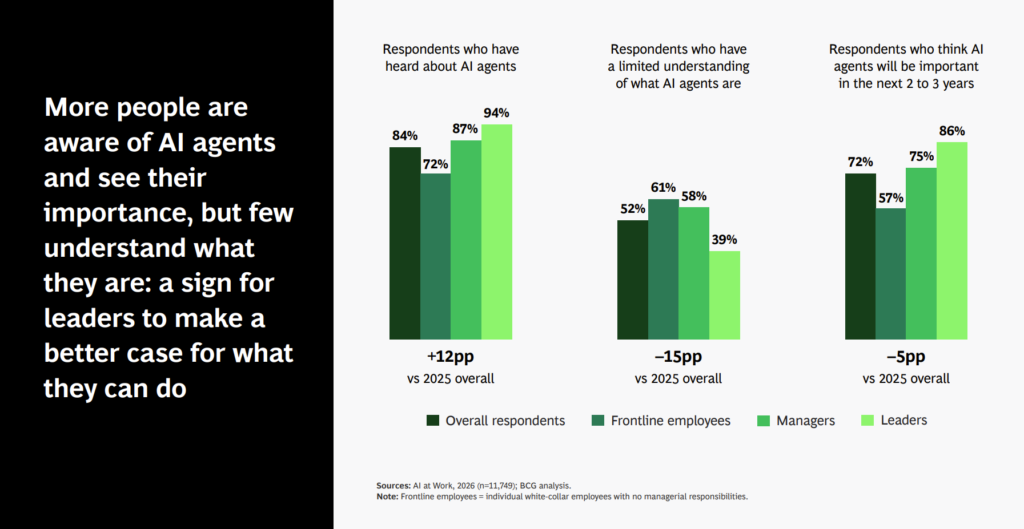
The catch: 52% of respondents still have a limited understanding of what AI agents actually are. And governance, meaning who’s accountable when an agent does something wrong, is lagging well behind the technology.
Knowing that something exists and knowing what to do with it are different things.
Strategy beats tools, by a lot
The report’s clearest finding is also its most inconvenient one for companies that have been buying AI tools and calling it a strategy.
Organisations with clear strategic direction see measurable business impact lifted by around 25 percentage points. Better tools alone, without that direction, move the needle by approximately 5 points.
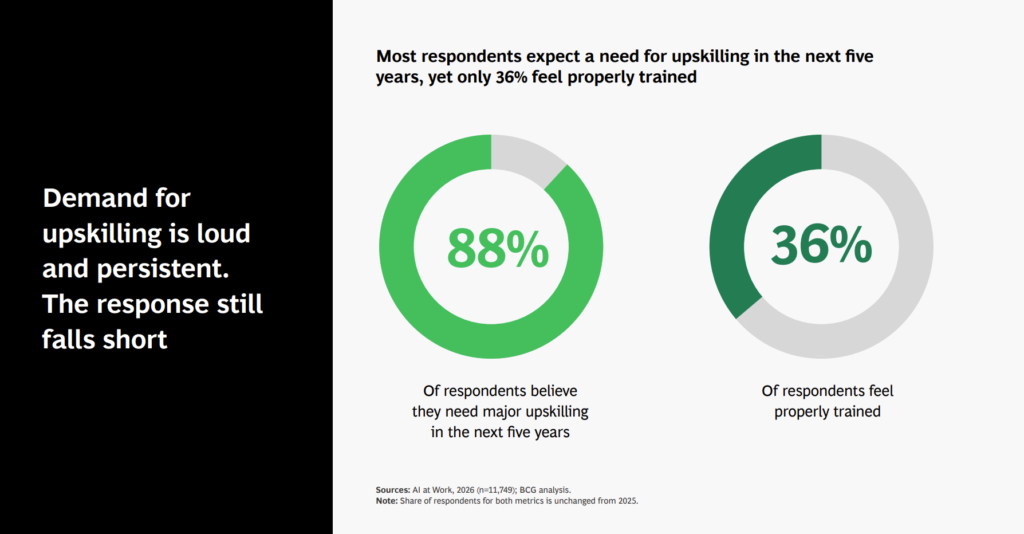
88% of respondents believe they’ll need major upskilling in the next five years. Only 36% feel they’ve received sufficient training. That number hasn’t moved since last year.