

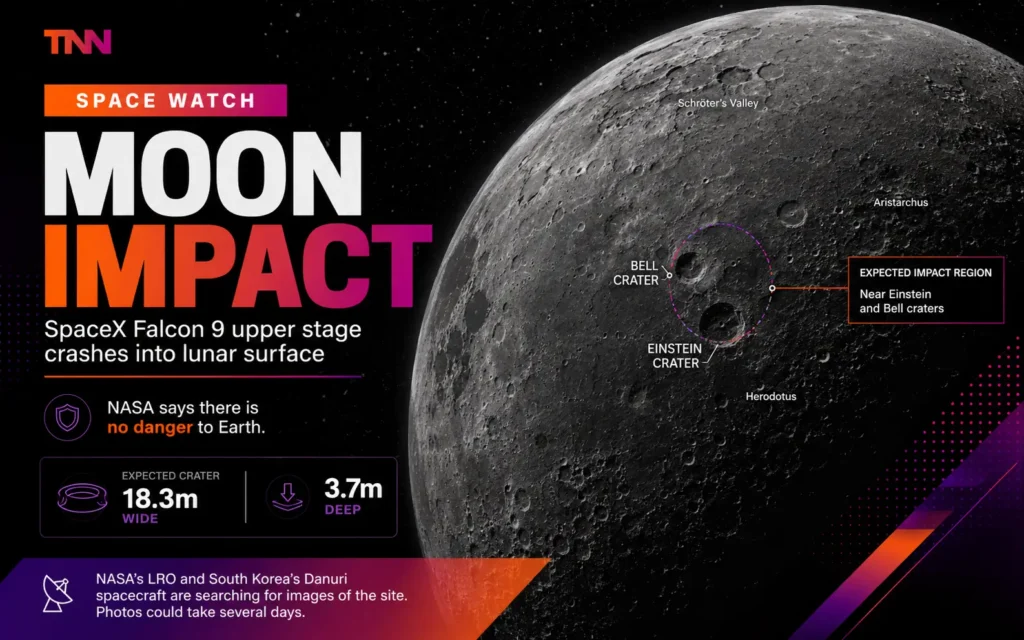
Yes, a spent SpaceX Falcon 9 upper stage struck the lunar surface on 5 August 2026 in an unplanned impact, and NASA moved immediately to observe it. NASA confirmed the impact poses no danger to Earth.[1]
Jimi Russell, the agency’s public affairs specialist, said NASA attempted to observe the event in real time using ground-based instruments, though the strike was not visible to the naked eye from Earth.
SpaceX rocket goes boom into moon
The upper stage is expected to have carved out a crater roughly 18.3 metres wide and 3.7 metres deep, throwing dust and rock outward as ejecta.[*]
That is a lot of displaced lunar real estate for something that was, until recently, someone’s rocket.
What the moon does and does not care about
NASA points out that the moon takes hits like this regularly. Because the moon has no atmosphere to slow incoming objects, it is struck by meteoroids daily. Human-made object impacts are far less common but do occur.
For context, NASA notes that a meteoroid carrying the same energy as this upper stage hits the moon roughly every six days. The lunar surface has been absorbing impacts with equivalent force on a near-weekly basis for billions of years.
Disposing of upper stages on the lunar surface is a technically accepted and safe method of end-of-life disposal. In some cases, a lunar impact can be the only practical option for missions operating in low lunar orbit.
Many operators choose controlled impacts precisely because they produce predictable, trackable outcomes.
What NASA is watching for next
According to NASA, AI in lunar exploration makes understanding such impacts increasingly important for future missions to the moon.
Despite the unplanned nature of this impact, NASA said observing it gives scientists valuable insight by revealing how ejecta plumes behave, helping to understand the moon’s geology and refine models that guide future exploration and science missions.
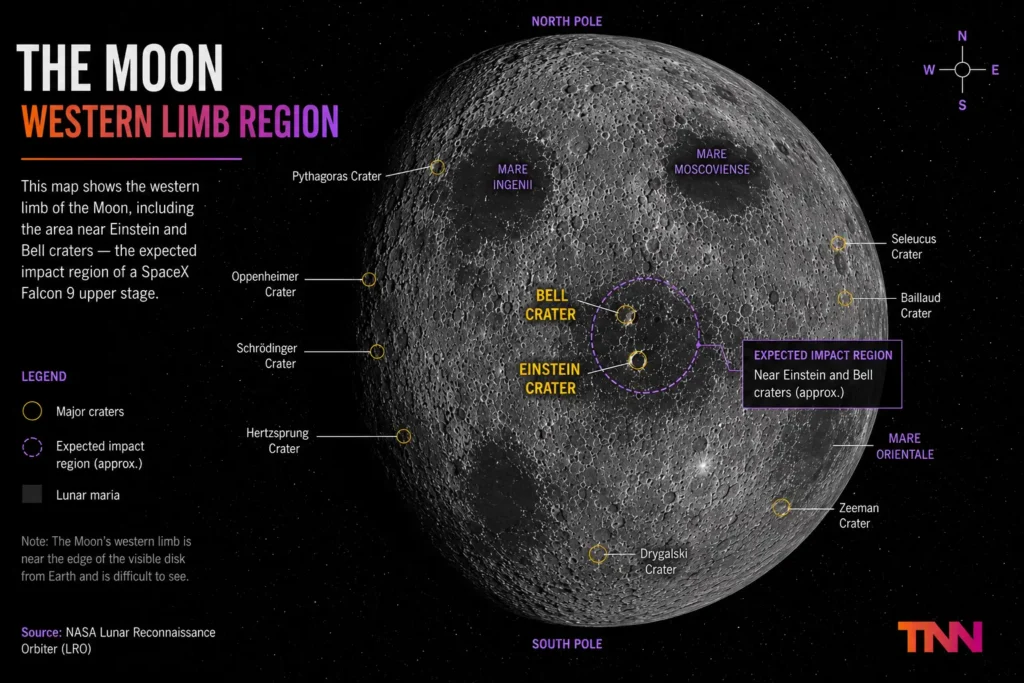
NASA’s Lunar Reconnaissance Orbiter and the ShadowCam instrument aboard South Korea’s Korea Pathfinder Lunar Orbiter will look for opportunities to image the site before and after the impact.[2]
Image availability will depend on lighting, orbital timing and spacecraft position, and it may take several days to receive any imagery.
NASA said any data collected will help scientists better understand artificial impacts and their implications for exploration. The agency will also continue tracking the object as part of training operations.
Sources:
[1] NASA, NASA Will Attempt to Observe Rocket Parts’ Lunar Impact, [Author Name], Aug. 5, 2026.
[2] The Korea Times, Korea’s Danuri Orbiter to Film SpaceX Rocket’s Collision With Moon, Yonhap, Aug. 3, 2026.
For more on ejecta:
[*] NASA, Ejecta in Excess.