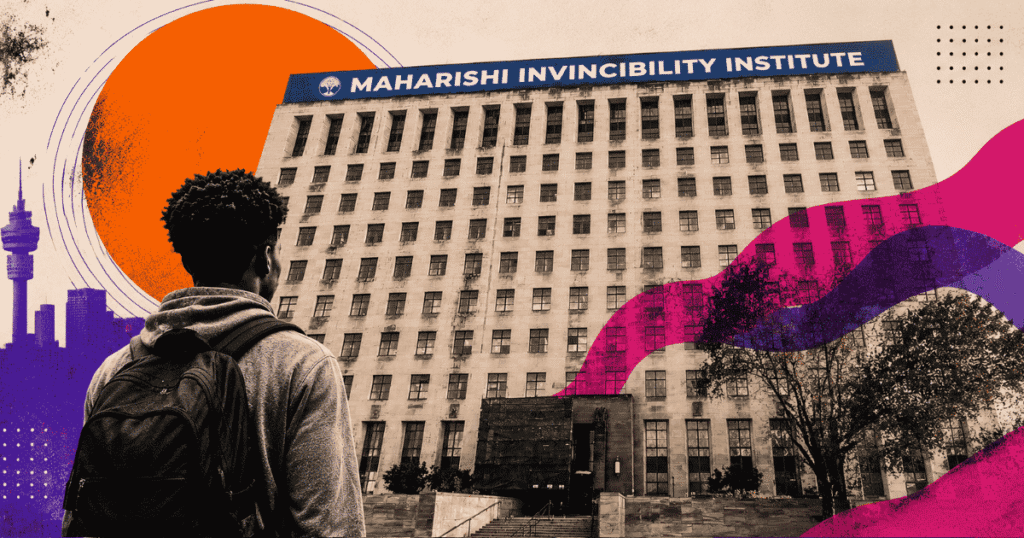

Unlike other universities, the Maharishi Invincibility Institute (MII) does not recruit from the top of the class. It defies the norm and recruits from the bottom.
I visited the MII on 4 June as part of Salesforce’s Agentforce World Tour Volunteer Time Off (VTO) Day, held at the Johannesburg campus a day after the Agentforce World Tour event at Kyalami.
The visit formed part of Salesforce’s 1:1:1 model, which commits 1% of the company’s equity, 1% of its products, and 1% of employees’ time to community impact initiatives.
This model resonated so strongly with me, especially after seeing it in action. Mora Media and TechNation News have committed to adopting the same principle.
Welcome to MII
Alongside Salesforce staff, partners, and media, I spent the morning experiencing parts of the daily routine MII students follow. We were keen to hear Dr Taddy Blecher walk us through some of the institution’s history and its long-term vision.
But before that, we were taken into a meditation session – a daily practice followed by all students and staff at MII.
Linda Raja Ali, a Transcendental Meditation teacher at the institution, led the session. First came Pranayama, specifically alternate nostril breathing, known in yoga as Nadi Shodhana. Right thumb on the right nostril, middle and ring fingers on the left, inhaling and exhaling through each side in turn.
After that, Linda walked us through the Ayurvedic practice of pulse reading, where three fingers placed along the wrist artery are meant to read the three doshas. Index finger for Vata, middle finger for Pitta, ring finger for Kapha.
Then 20 minutes of silence.
It is a strange way to start a business visit. It is also, by the time Blecher finishes explaining the PTSD data, obviously not accidental.
The Maharishi Invincibility Institute’s mission
Seventy percent of the students MII accepts are not eligible for university admission in South Africa, meaning they did not get the matric scores required to qualify. Some have not passed Grade 12 at all.
The institution takes them anyway, puts them through higher education and professional training programmes, and then tracks every single one of them after graduation.
So far, 25,595 people have been through the programme. Nearly all of them were unemployed when they arrived. In South Africa, that is hardly unusual. According to Stats SA, more than 4 in 10 young people aged 25 to 34 are unemployed, and more than 6 in 10 South Africans aged 15 to 24 are unemployed.[1]
To date, more than 22,000 MII graduates have been placed into quality jobs. Their combined first-year earnings stand at R2.2 billion.
If those graduates work until retirement without ever receiving a single salary increase, MII estimates they will conservatively earn over R82.95 billion in their working careers. This means billions of rands will be flowing into the economy, and back into families who genuinely need it.
The MII origin story
Dr Taddy Blecher, co-founder and CEO of MII, started with a question. He wanted to know whether the best universities in the world are genuinely excellent, or whether they are just very good at taking excellent people and not ruining them.
His argument is the latter. To get into Harvard, you need to be in the top 0.1% of the population. The students Harvard produces are extraordinary. But Blecher’s view is that any institution can produce extraordinary outcomes from extraordinary inputs.
Much to the delight of his audience, Dr Blecher said: “Any idiot can take a genius and turn them into a genius. It’s not that hard, you know. You take somebody who comes out of school with like eight As, nine As. And it’s not hard to work with people who are the superstars of your society.”
MII’s goal is to “set out a hundred thousand times to prove that there is no such thing as an ordinary person.” Dr Blecher says they want “to prove, and what we believe real education is, is to shift the whole bell curve to the right and prove that everybody has this exceptional ability.”
He has been doing that since MII was founded in 2007.
The MII model
The institution is built on what Blecher calls Consciousness-Based Education.
The underlying premise is simple and taken seriously: you cannot learn when you are hungry, when you are traumatised, when the environment around you is dangerous, or when the system treats you like an input rather than a person.
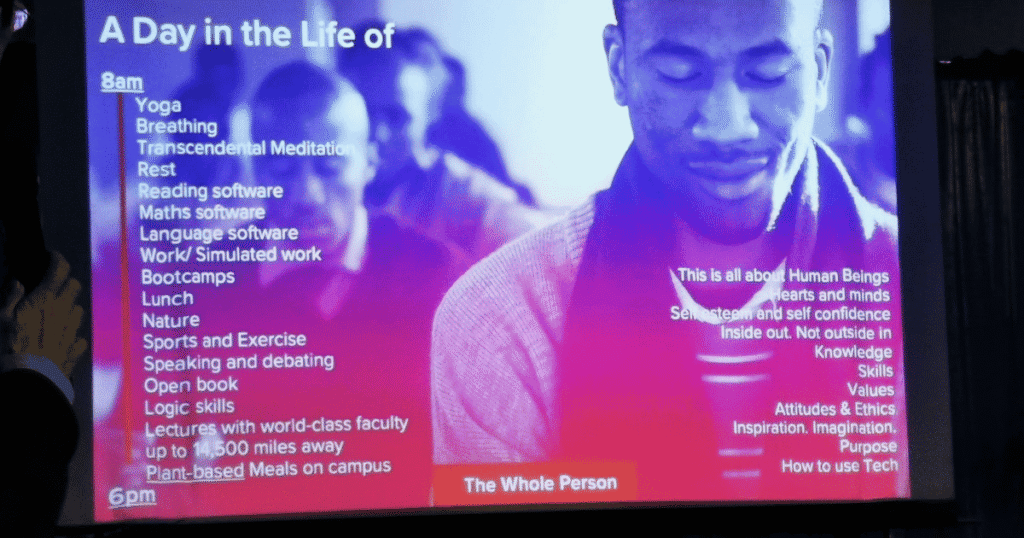
The day at MII starts at 8am and ends at 6pm. It includes yoga, Pranayama breathing exercises, Transcendental Meditation, and rest, followed by degree coursework, industry-specific training, and afternoon sports.
Students receive plant-based meals daily, and the institution also operates a Montessori preschool for students who are young mothers. It provides books, materials, counselling, trauma reduction, and part-time income while studying.
Blecher showed data on the mental health profile of incoming students. Using the same PTSD assessment test the US military applies to veterans returning from Afghanistan and Iraq, 36% of MII’s incoming students test positive for full post-traumatic stress disorder.
A further 30% show elevated PTSD levels. Only 34% fall in the normal range. On the Beck Depression Inventory, 40% of incoming students show chronic depression.
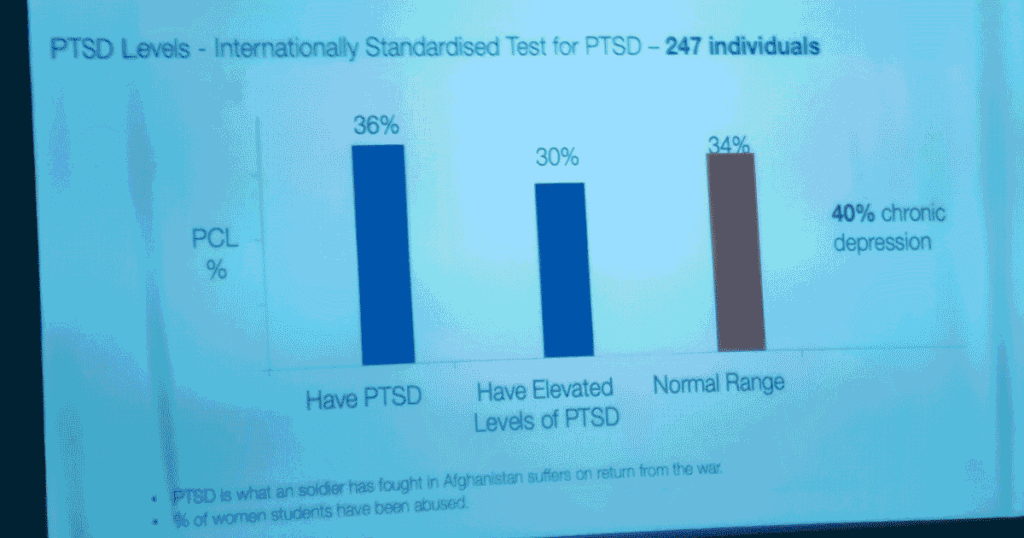
Let’s take a moment to sit with this for a while. Read the last two paragraphs again. Let it sink in:
More than a third of MII’s incoming students are presenting with the same PTSD levels as soldiers returning from active combat (during peacetime, in a country not actively engaged in war).[2]
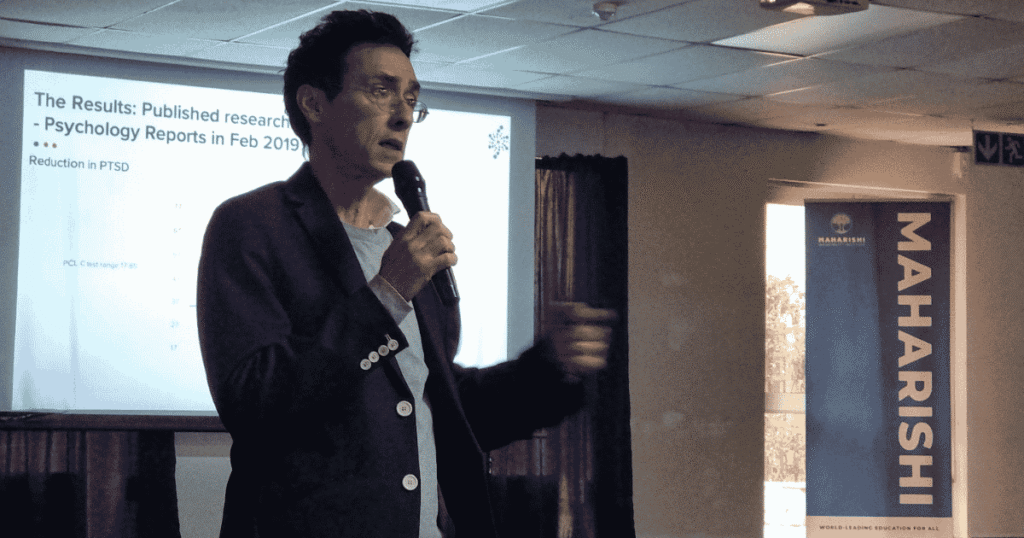
Dr Blecher says university students are more depressed by their third year than they were in first year. At MII, both PTSD and depression markers drop significantly within 60 days of enrolment.
This is documented. Published research shows the reduction in PTSD scores across a cohort of students, tracked using the PCL-C scale.[3]
That is the base the institution builds everything else on.
What it does differently
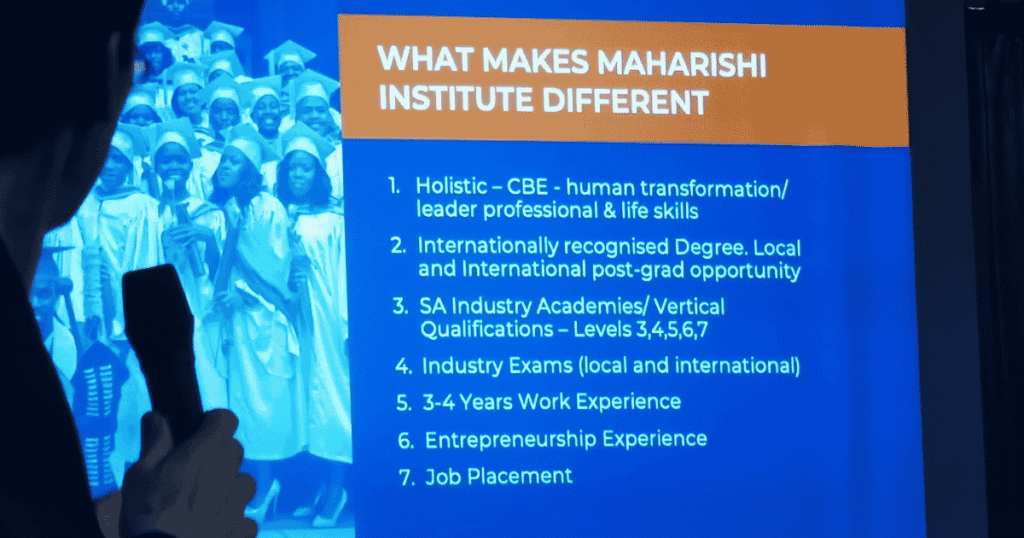
Where a conventional degree program focuses on academic content, MII adds a vertical qualification layer on top. The proposed Salesforce Academy, for example, would run as a full three-year program alongside the degree.
Students would write the global Salesforce certification exams, additional IT exams, accumulate work experience during study, and get placement support into the Salesforce ecosystem when they graduate.
The wider curriculum includes 3 to 4 years of work experience across all programs, entrepreneurship training, industry exams, and job placement.
The model’s ethos, in Blecher’s words, is “open access, pay it forward.”
Students who can demonstrate family income above R10,000 per month combined do not qualify. The institution runs a means test to ensure it reaches people who cannot access any other pathway.
MII awards
MII has received 37 national and international awards.
Stanford University cited MII in its 2025 publication, Reimagining Higher Education, as one of the twelve most innovative educational institutions globally, and one of only two from Africa.
Stanford’s description of the institutions selected: “Bold visionaries continue to shed the constraints of what higher education has traditionally looked like; they are creating radical new models increasing access for a more diverse set of students, enabling them to better bridge the academic institution and the world they enter after graduating.”
Other awards include the The Nedbank Prosperity Sustainability Award, the Bahrain Global Education Award, and Global Banking Tech and Global Cyber-Security Awards for its ABSA CyberSecurity Academy.
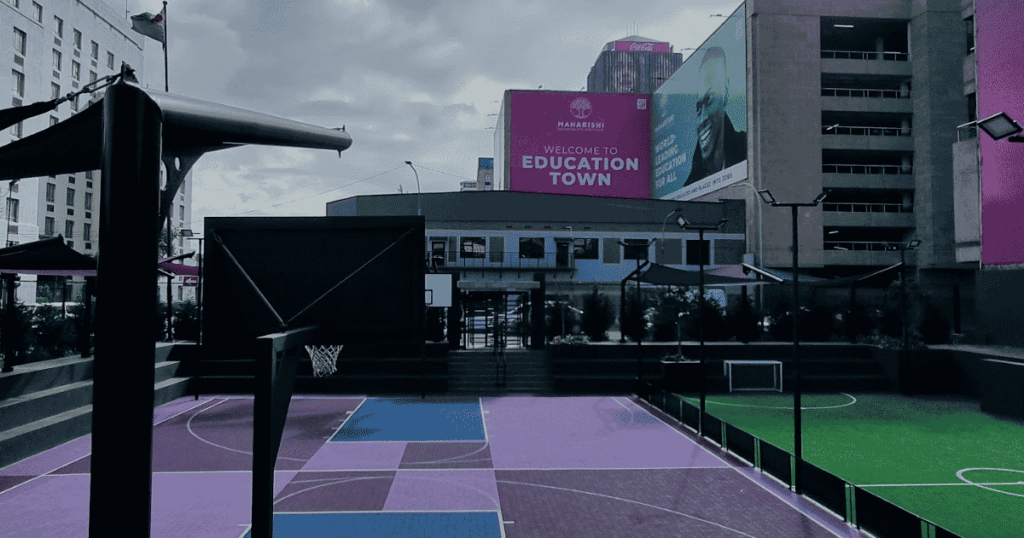
The Education Town
MII is attempting to reclaim the Johannesburg inner city.
The campus anchor is a 43,000 square metre building at 45 Main Street in Marshalltown, donated by Anglo American. The value of the donation, including refurbishment, was over R230 million.
MII acquired it for R2.30. When Dr Blecher asked why specifically R2.30, Anglo American said it was R1 for the building, plus VAT on the R20 million in furniture included in the sale. The building can accommodate 3,500 students and currently holds around 2,000.
Fun fact, that building sits approximately where, 140 years ago, gold was discovered in South Africa. The reef that built Johannesburg intersected with the surface right here. Anglo American was formed in that era and spent the first century of its existence in this part of the city before moving to Rosebank.
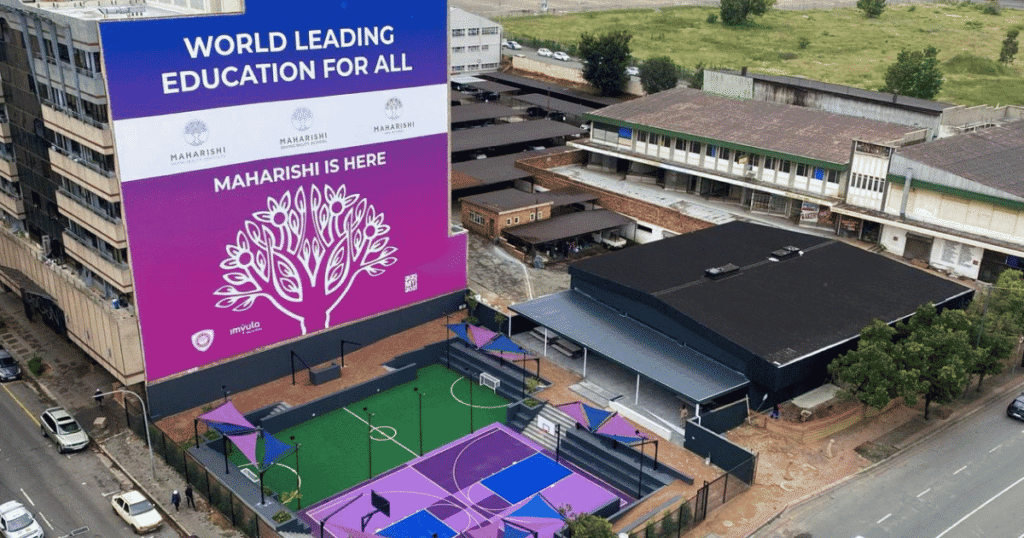
MII now controls buildings across the inner city. According to Blecher, the total land area held across MII’s multiple sites amounts to over 15% of the Johannesburg CBD.
The urban work is not optional to the model
When Blecher started a free university, the street lights did not work at night. The area was also known for gang activity. He said he could not run an institution students could safely access.
So he began changing the city around it.
MII installed 650 solar street lamps in the surrounding area.
Rand Merchant Bank was reportedly inspired by this and is now funding the replacement of 7,500 further street lights across the city at a cost of R21 million.
A former drug den under a council bridge was bought, cleared, and converted into a sports facility.
A piece of land on the original gold reef, donated by Standard Bank, went from a hijacked building run by a gang to the Josie Field of Dreams, the first full-size soccer field in the Johannesburg CBD. It was built in under three months.
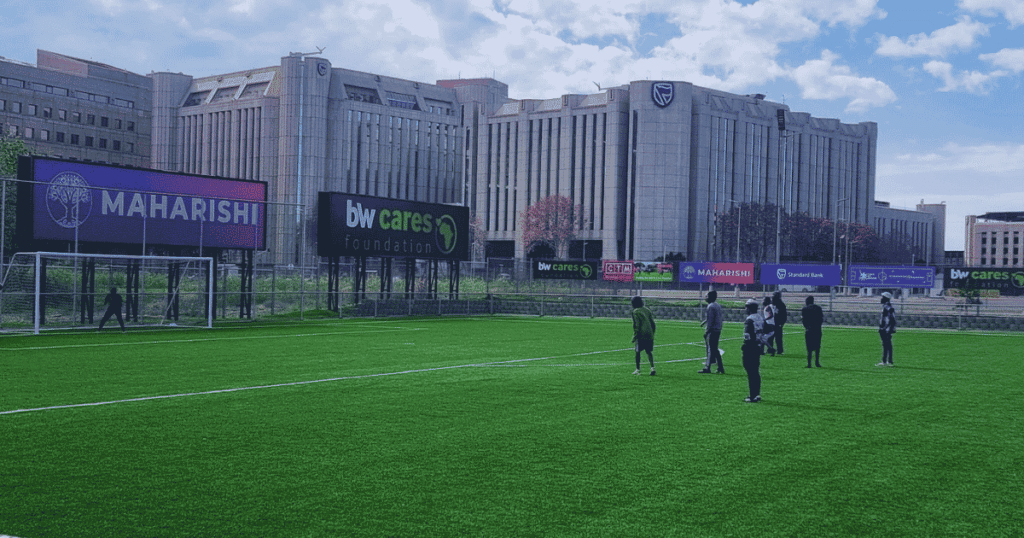
A full-size rugby field called the Field of Giants is under construction on the actual site where the gold reef surfaces, with plans to have the Springboks inaugurate it early next year.
Safety for all
The security operation is built in-house.
MII runs a Security Mastery Academy with 500 students in a three-year program. A standard security officer in South Africa receives between three and six weeks of training. MII’s graduates train for three years, learning jiu-jitsu, boxing, cybersecurity, crowd control, and even drone operation.
In addition, CAP Community Security, the company MII partners with, has reduced violent crime by 80% in 80 areas across Johannesburg where it operates.
According to Blecher, citing their research, there are approximately 700 violent criminals operating in Johannesburg. Around 400 have been jailed.
The argument Blecher makes is that most crime in South Africa is petty crime driven by hunger and desperation, not violent crime. The violent criminal cohort is relatively small and trackable. Clear them out, create employment, give people purpose, and the safety will be restored.
What comes next
MII has officially launched the Maharishi NextUp Institute of Technology (MNIT), a new campus at 56 Main Street in the Marshalltown district. The campus is housed in a 10-storey building donated by tech entrepreneurs and philanthropists David and Tracey Frankel.
Tech firm Altron has signed on as the anchor tenant, with the institute focused on AI, robotics, automation, cybersecurity, cloud engineering, digital design, digital marketing, and data science.
Blecher said the vision is for the Salesforce Academy to sit within MNIT alongside initiatives involving Google, PricewaterhouseCoopers, Deloitte, ABSA, and others.
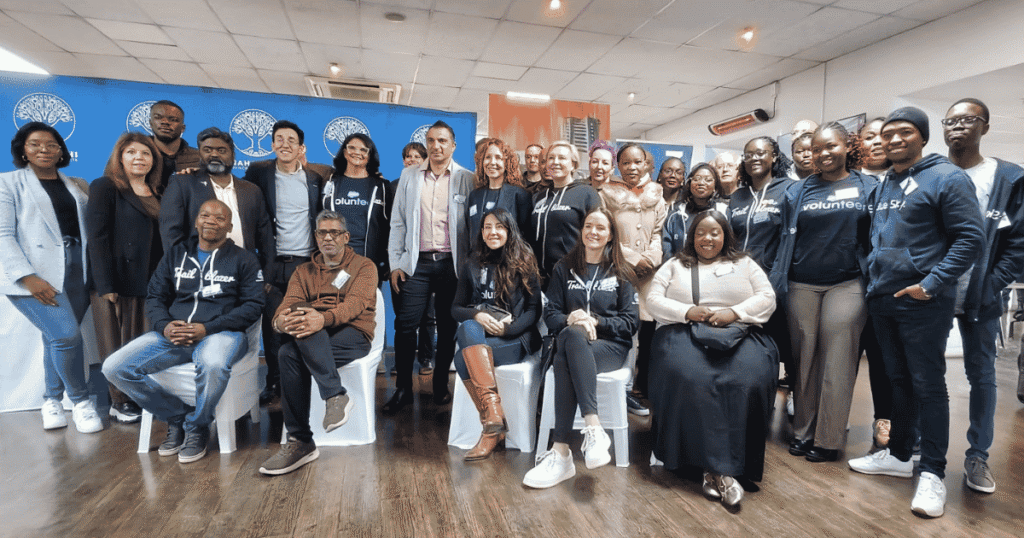
“The greatest need your customers are facing is a need for skills and deep skills in Salesforce,” Dr Blecher told the room. “If you had the skills, they would be able to do these robust implementations.”
The numbers, and the question
MII claims its 5,000 entrepreneurs, trained in partnership with the Branson Centre of Entrepreneurship, are included in the graduate count. Combined first-year earnings across all graduates and entrepreneurs total R2.2 billion.
The long-run career earnings projection is R82.95 billion. Those 25,595 graduates support an estimated 175,000 family members.
Dr Blecher says his target is a trillion rand. One hundred thousand graduates, R10 billion in first-year combined salaries, R1 trillion in lifetime earnings.
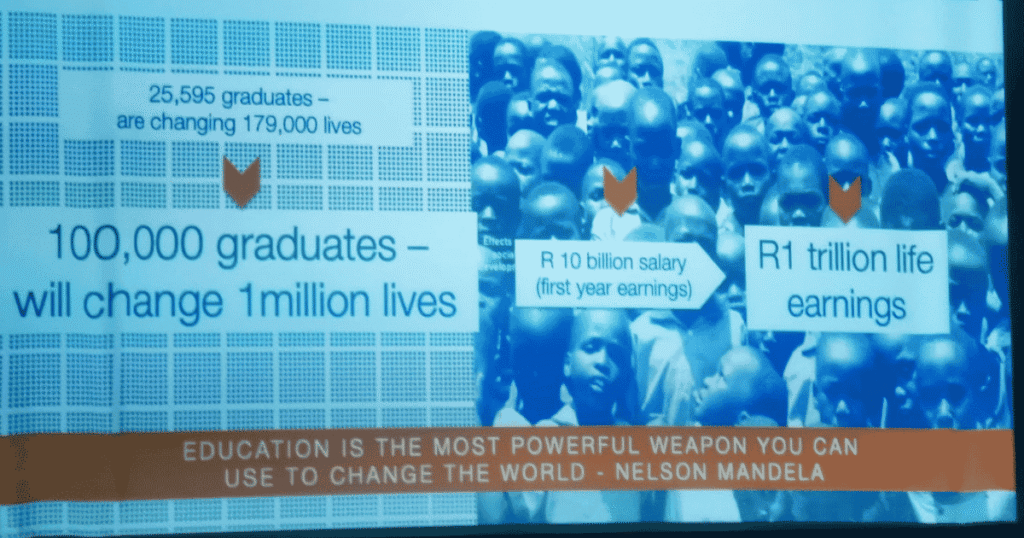
That is the slide Blecher puts up. It quotes Nelson Mandela: “Education is the most powerful weapon you can use to change the world.”
Blecher is a qualified actuary. He knows numbers, and he is not in the habit of understating them.
Asked during Q&A whether he intended to influence policing policy, he said MII tends to “stay very apolitical and just focus on the work. Our job is to prove what is possible. And to help transform lives at a massive scale.”
The plan is to produce a generation of leaders with different values, ethics, and skills, and let them go into every institution in the country.
“Our old leaders have been there way too long,” he said. “There’s just a bankruptcy of ideas. We’ve got to generate a new generation.”
REFERENCES:
[1] Statistics South Africa. (2026). South Africa’s Youth and the Labour Market in Q1 2026. Quarterly Labour Force Survey (QLFS), Quarter 1 2026. Retrieved from statssa.gov.za.
[2] Suliman S, Kaminer D, Seedat S, Stein D. Assessing post-traumatic stress disorder in South African adolescents: using the child and adolescent trauma survey (CATS) as a screening tool. Ann Gen Psychiatry. 2005 Jan 31;4(1):2. doi: 10.1186/1744-859X-4-2. PMID: 15845137; PMCID: PMC1088008.
[3] Bandy, C. L., Dillbeck, M. C., Sezibera, V., Taljaard, L., Wilks, M., Shapiro, D., de Reuck, J., & Peycke, R. (2020). Reduction of PTSD in South African University Students Using Transcendental Meditation Practice. Psychological Reports, 123(3), 725-740.