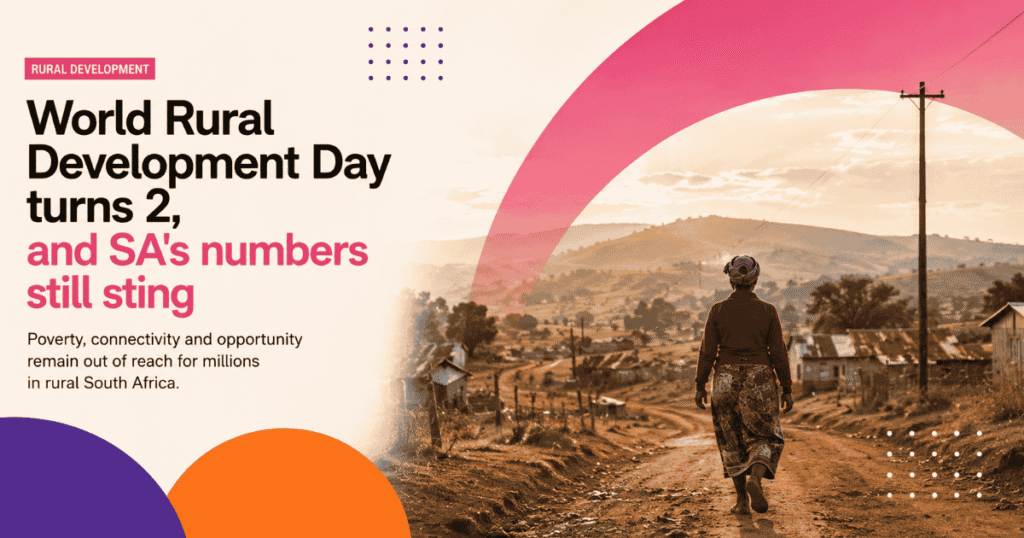

Today is only the second time the world has marked World Rural Development Day. The UN General Assembly declared 6 July as the annual observance in September 2024, through resolution A/RES/78/326, and the inaugural day was held last year.
So this is still new. Which makes it a good time to ask whether the rhetoric is keeping pace with the reality. I don’t think it is…
World Rural Development Day
This year’s theme is “Rural Communities Cultivating Sustainable Development for All.” The Mandela Institute for Development Studies, one of South Africa’s more prominent voices on African leadership and rural empowerment, acknowledged the day by saying Africa’s future is deeply rooted in the strength and resilience of its rural communities.
That’s true. It’s also uncomfortable, because the data shows those communities are carrying a disproportionate share of the world’s hardship.
The numbers
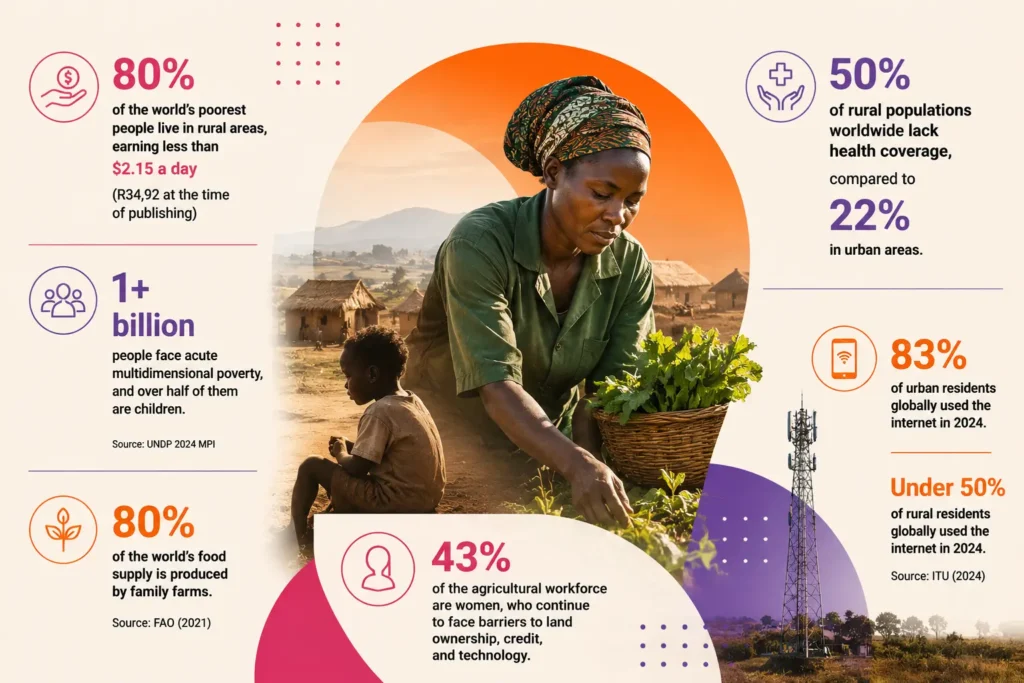
Globally, 80% of the world’s poorest people live in rural areas, and they earn less than $2.15 a day (R34,92 at the time of publishing). More than one billion people face acute multidimensional poverty, and over half of them are children, according to the UNDP’s 2024 Multidimensional Poverty Index.
Half of all rural populations worldwide lack health coverage, compared to 22% in urban areas. Family farms produce 80% of the world’s food supply, according to the UN’s Food and Agriculture Organization (FAO) (as of 2021), while women make up 43% of the agricultural workforce and continue to face barriers to land ownership, credit, and technology.
ALSO READ: Africa’s water crisis steals 40 billion hours from women and girls every year
The digital divide is just as stark. In 2024, 83% of urban residents globally used the internet. In rural areas, the figure was under 50%, according to the International Telecommunication Union (ITU).
SA’s version of this problem
South Africa has 64.9 million people; about 30% of them (roughly 19.5 million) live in rural areas. And the shape of rural poverty here isn’t accidental.
The geographic distribution of hardship in South Africa still maps almost directly onto the apartheid-era homelands: barren, deliberately underdeveloped regions packed with people and stripped of infrastructure, jobs, and investment.
The Eastern Cape, one of the most rural provinces, has around 880,000 people living in poverty. Limpopo follows a similar pattern.
The digital gap compounds everything else.
South Africa’s digital gap
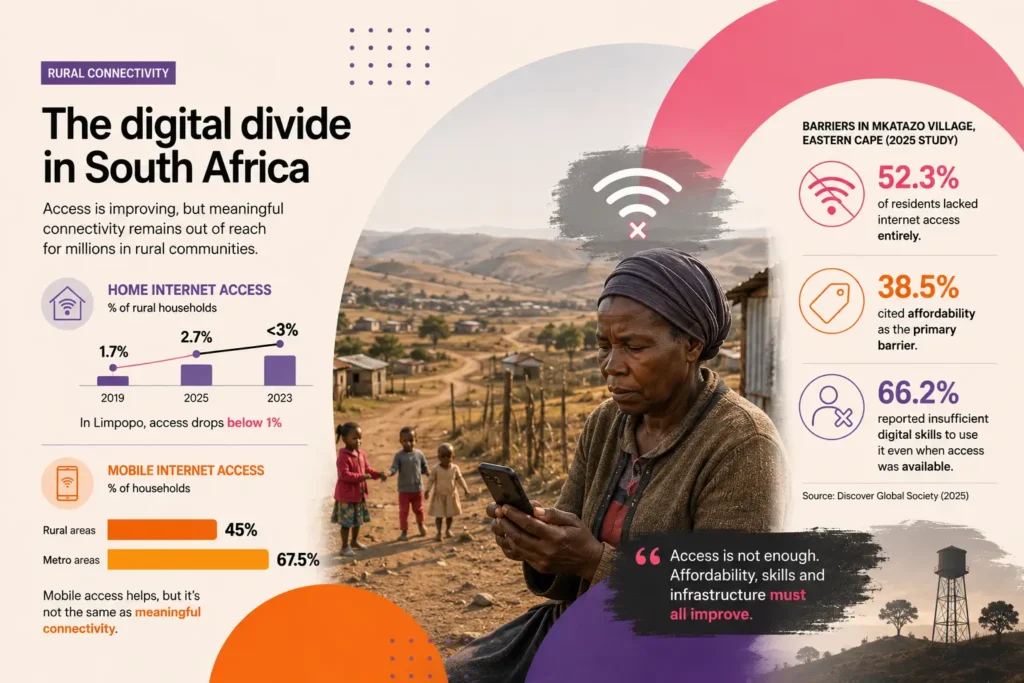
According to Stats SA data from 2023, less than 3% of households in rural areas have access to home internet. This figure was 1.7% in 2019, and was 2.7% in 2025. In Limpopo specifically, that figure drops below one percent.
Mobile internet has partially bridged the gap nationally, with mobile access reaching around 45% of rural households, compared to 67.5% in metros. But mobile access and meaningful connectivity are not the same thing.
A 2025 study published in Discover Global Society, examining Mkatazo village in the Eastern Cape, found that 52.3% of residents lacked internet access entirely, 38.5% cited affordability as the primary barrier, and 66.2% reported insufficient digital skills to use it even when access was available.
South Africa nationally has around 51.7 million internet users, roughly 79% of the population, which sounds healthy until you remember that 13.3 million people remain offline. Most of them are rural.
ALSO READ: The case for putting young Africans in charge of water governance
What World Rural Development Day is actually asking for
The UN resolution isn’t ceremonial, or at least it’s not supposed to be. It calls for governments to invest in rural infrastructure, for international development institutions to create policy platforms on inclusive land management and financial access, for academic institutions to drive rural innovation, and for the private sector to build inclusive business models and investment funds aimed at rural entrepreneurs.
It also designates 2026 as the International Year of the Woman Farmer, recognising what the data already shows: women are doing nearly half the agricultural work globally while being systematically excluded from the tools and rights that would make that work sustainable.
South Africa has frameworks on paper.
- The National Development Plan identifies ICT as a critical enabler for economic activity and social development.
- SA has electronic communications legislation and a broadband policy.
What it doesn’t have, consistently, is the infrastructure rollout and affordability that would make any of that mean something to a household in rural Limpopo.
Does the rhetoric catch up?
Two years in, World Rural Development Day is still finding its footing as a global observance. The theme is right but the stats are not new, and still not looking good.
South Africa’s rural communities already know what the problem is. The question the day is really asking is who has the authority and the will to do something about it, and whether a UN resolution is enough to move that needle.
The homelands were designed to fail, but reversing that by accident isn’t going to work either.
NOW READ: The students no one wanted. The results no one expected