
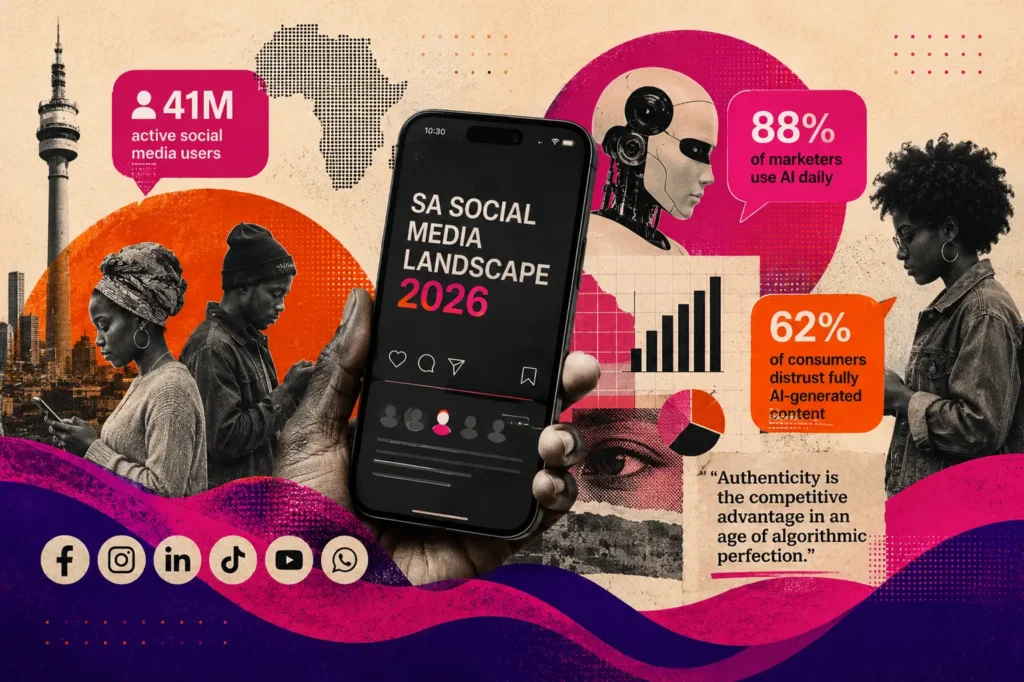
South Africa has nearly 41 million active social media users, 88% of marketers are using AI daily, and 62% of consumers openly distrust fully machine-generated content.
Hold that contradiction in your head for a second.
Ornico and World Wide Worx released their 2026 South African Social Media Landscape Report this week, now in its 16th year, and the theme is quite fitting: the human edge.
What stays valuable about people when the machines can do most of the production work?
Exactly.
SA Social Media Landscape Report 2026
The webinar unpacking the findings was hosted by Oresti Patricios, CEO of Ornico, and brought together Arthur Goldstuck, MD of World Wide Worx; Dr Mark Nasila, Chief Data and Analytics Officer at FNB Risk; Jezile Dhlamini, Chief Client Officer at Ask Africa; Karen Denny, Divisional Executive of Digital Marketing at Standard Bank Group; and Tumelo Motingoe, Senior Media Manager at Old Mutual.
Here’s a recap of what came out of it.
The AI paradox
Eighty-eight percent of marketers are using AI daily. Sixty-two percent of consumers distrust content they believe was fully generated by machines.
Those two numbers are doing a lot of damage to each other.
Patricios framed it during the webinar: South African brands using heritage storytelling, described as unpolished, honest narratives rooted in shared human experience, are dramatically outperforming high-gloss AI-generated content.
“Authenticity is the competitive advantage in an age of algorithmic perfection,” he noted.
The report summary reinforces this: 73% of companies are now using AI in general, with ChatGPT still dominant at 72% for social content production. But Anthropic Claude has jumped from 9% to 29% of companies, making it the fastest-growing AI tool in the survey. Google Gemini sits at 35% and Microsoft Copilot at 30%. Claude is closing in on both.
Watch the full webinar here:
The data also shows brand returns from social media at their lowest since 2023. Sales as a reported return has fallen from above 40% to below 30%. Brand awareness remains the top-cited return at 69%, which Goldstuck flagged as potentially convenient rather than meaningful:
“My gut feel is that that is the easy way out. You can claim brand awareness if you can’t prove actual return on investment.”
On the new technology front, only 55% of brands have allocated budget for it, the lowest in three years. Half of large corporations are not spending on new tech until they see proof it works.
“AI in particular still has to prove itself in the marketing environment,” Goldstuck noted.
LinkedIn is winning the corporate race
The biggest brand-side story in the report is LinkedIn’s continued climb. (I myself am quite fond of LinkedIn. If they can fix their gender bias problem, it would easily be one of my favourites.)
Corporate usage of LinkedIn has reached 88%, up from 85% in 2025, making it the most widely used company platform for the second year running.
Facebook follows at 79%, down from 83%. Instagram has slipped from 73% to 69%. WhatsApp, however, has made a significant jump, from 45% to 57%, quietly strengthening its position as a company communication tool. YouTube dropped from 63% to 50%.
On advertising spend, LinkedIn jumped from 25% to 36%, its highest ever. Facebook dropped from 40% to 37%. Instagram climbed from 12% to 17%. X sits at 4% and, as Goldstuck put it, isn’t recovering any time soon: “They’re not going to recover until their image of toxicity is beaten back to some extent.”
He also offered a reading of the X user base that is worth sitting with. The platform’s strongest penetration is among higher-income users, and the lower-income brackets barely use it.
“The higher your income the more entitled you feel,” Goldstuck said. “And I would argue that this indicates that entitlement is actually the fuel for the toxicity of X.”
Very well said.
Brands are still scared of the mighty TikTok
On the consumer side, TikTok has grown from 34% regular usership in 2023 to 47.9% in 2025, with its highly active user base rising from 32.4% to 40.0% in the same period.
Goldstuck described it plainly: “The rise of TikTok is a juggernaut. A steamroller that is coming for all other social networks.”
Yet corporate activity on TikTok actually declined, from 47% in 2025 to 37% in 2026.
The reason, according to Goldstuck, is corporate planning culture. TikTok trends move faster than budget cycles. “You’re typically planning a budget over the next one to two years and the TikTok user is changing their entire thinking around TikTok every few weeks,” he said.
Sixty-eight percent of companies still plan to use short-video platforms in the future, so the intent is there. The execution is the problem.
Facebook, meanwhile, has bounced back on the consumer side to 61.8% active usage, its highest yet, after dropping to 56.2% in 2024. Instagram recovered strongly from 27.6% in 2024 to 33.3% in 2025. LinkedIn has grown to 19.3% of consumers, almost catching X at 19.9%. Pinterest is now at 15.6%, Threads at 10.4%, and Reddit has entered the picture at 8%.
Dhlamini pointed to why usage is growing across all platforms despite concerns about AI and bot content: young South Africans are using social media as their primary search engines.
“They get information around brands, products and content and look at social media from an inspiration perspective as well,” she said.
ALSO READ: WhatsApp usernames are coming. Here’s how to claim yours first
A year in the Numbers
The 2026 findings make more sense when you put them next to 2025.
Last year’s report, themed Fake Identities: The Era of Digital Doubles, was already sonding the alarm on trust and authenticity. The 2026 “Human Edge” theme is the same conversation, one year further down the road.
The platform numbers tell a clear story in three directions.
- Facebook dropped to 56.2% active usership in 2025 and has bounced back to 61.8% in 2026, a notable recovery.
- TikTok moved from 38.6% in 2025 to 47.9% in 2026, adding nearly 10 percentage points in a single year.
- LinkedIn’s consumer penetration has climbed consistently: 12.2% in 2023, 15.8% in 2025, and now 19.3% in 2026.
- Three years of uninterrupted growth on a platform most people still think of primarily as a job-search tool.
On budgets, the picture has actually gotten worse. In 2025, 53% of companies spent under R10,000 per month on social media advertising. In 2026, that’s risen to 60%.
High-end spenders, those above R50,000 per month, have dropped from 23% to 16%. 54% plan to increase budgets in the year ahead, but only 23% have actually done so yet.
Screen fatigue is real
Dhlamini confirmed that screen fatigue and a drop in engagement quality are visible in the data, driven by sheer content clutter. Her prescription: cultural fluency. Brands that build meaningful, culturally relevant communication are the ones breaking through.

Old Mutual’s Motingoe described how his team measures success in that context. The goal is sustained engagement, not skippable impressions.
“For us it all comes down to how does the social media activity we do gets people into and down the funnel to ultimately get to that lead aspect or a sales opportunity,” he said.
Karen Denny from Standard Bank described AI as a background tool rather than a content engine.
“We use AI kind of in the background just to sense check ourselves and to check that there’s no typing errors and the construct is correct. But I think still as brands we need to show up very authentically,” she said.
A timely warning
The report closes with a quote from Timothy Spira, and it lands differently than most industry report soundbites.
“A lot of brands are about to discover that what they took for loyalty is just the customer’s lack of time and energy to find a better option. When agents make it effortless to evaluate and switch, brands will have to compete on genuine value.”
That’s the agentic AI era in one sentence, basically. When switching friction disappears, brand loyalty stops hiding bad products.
ALSO READ: The world is moving to Wi-Fi 7. Africa is still on Wi-Fi 4