
Africa is still running on Wi-Fi 4 while the rest of the world is moving on. It’s not a good look….
The global Wi-Fi upgrade cycle is well underway. Between Q1 2022 and Q1 2026, Wi-Fi 6’s share of global connections climbed from 6% to 27%. Wi-Fi 7, only just entering the market, has already captured just under 2% globally.
The direction is clear but Africa is not moving at the same pace.
Wi-Fi in the world
A new analysis from Ookla[1], tracking Speedtest data across four years of Wi-Fi generation adoption, shows the continent is still anchored to older infrastructure. Wi-Fi 4 accounts for 48.8% of Wi-Fi usage across Africa.
The 6 GHz band, which underpins Wi-Fi 6E and Wi-Fi 7 performance, recorded a 0.0% share of Wi-Fi samples across the continent in Q1 2026. South Africa registered a marginally better 0.2%, but that is still effectively zero at scale.
What the global picture looks like
Globally, Wi-Fi 5 and Wi-Fi 4 are declining. Wi-Fi 5 fell to 39% share and Wi-Fi 4 to 34% by Q1 2026. Wi-Fi 6 has become the dominant modern standard, and Wi-Fi 7 is beginning its commercial rollout.
Band usage tells its own story though. Just under 60% of global users now connect via the 5 GHz band, which offers faster speeds and less congestion than the older 2.4 GHz band. The 6 GHz band, which requires newer hardware and regulatory spectrum allocation, remains globally fragmented at 1.7% of samples.
One finding worth noting: device hardware is not the main bottleneck.
The majority of global Speedtest samples from Android devices, 61.4%, already support Wi-Fi 6 or newer.
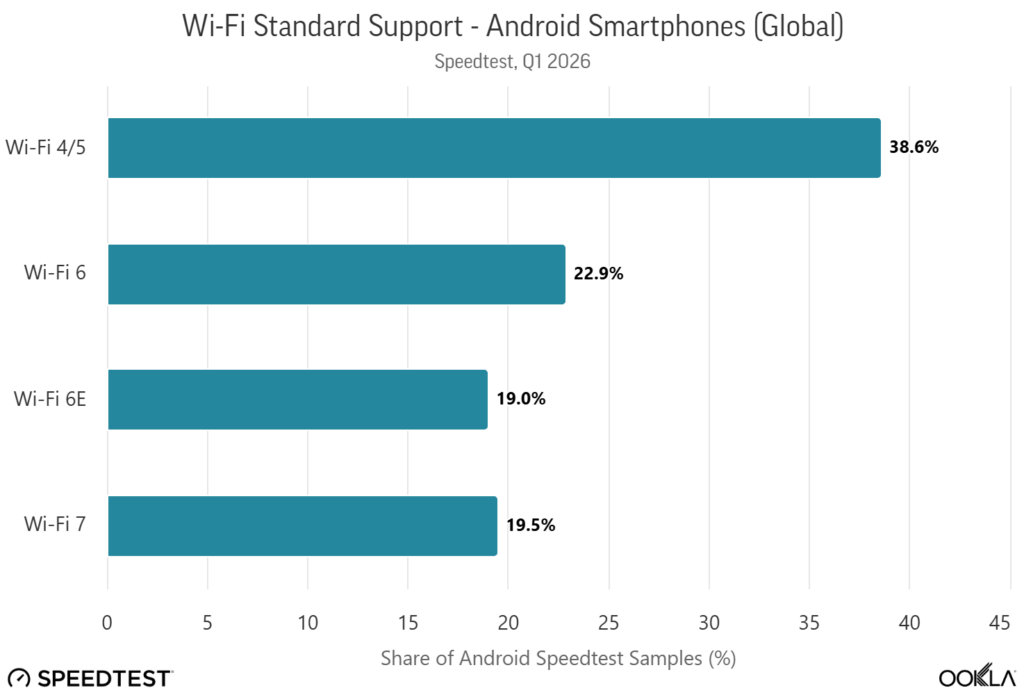
So hardware is not really the problem here. It is what they are connecting to.
Where Africa stands with Wi-Fi
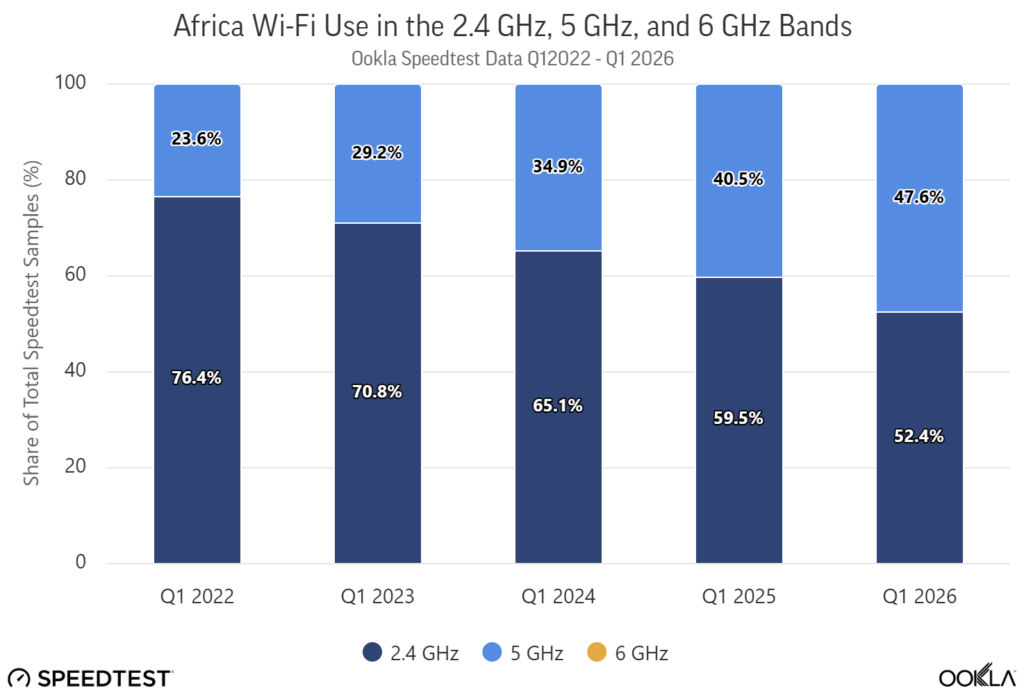
The continent has made progress. In Q1 2022, the 2.4 GHz band accounted for 76.4% of African Wi-Fi traffic. By Q1 2026, that had dropped to 52.4%. The 5 GHz band grew from 23.6% to 47.6% over the same period, which reflects genuine infrastructure investment and a shift in router hardware across corporate and residential environments.
Wi-Fi 5 grew from 19.9% to 34.4% market share in Africa between 2022 and 2026. Wi-Fi 6 grew from 1.6% to 16.8%. Both figures represent real movement, but the baseline was low and the pace remains behind the global average.
Wi-Fi 7 made up 0.1% of African samples in Q1 2026.
The 6 GHz spectrum situation is a structural issue, not just a device one. Regulatory approval for 6 GHz Wi-Fi use varies by country and remains limited across much of the continent. Without spectrum access, Wi-Fi 6E and Wi-Fi 7 cannot operate to their capacity regardless of what hardware is deployed.
ALSO READ: AI in Africa: Ministers confront AI anxiety and the data divide driving it
What this means in practice
The gap between Africa’s Wi-Fi infrastructure and the global curve has implications beyond connection speed. Wi-Fi 6 and Wi-Fi 7 are designed for environments with many simultaneous connected devices, which is increasingly the reality in homes, offices, and public spaces.
Higher capacity, lower latency, and better performance in dense environments are features built into newer standards that older infrastructure cannot replicate.
South Africa sits closer to the global trajectory than the broader African average. The 5 GHz band is now the primary carrier for much of the country’s indoor internet traffic, and Wi-Fi 6 adoption is accelerating. But the 6 GHz opportunity remains largely unrealised.
References:
[1] Marek, S. & Giles, M. (2026). The Global State of Wi-Fi. Ookla. Retrieved June 10, 2026,