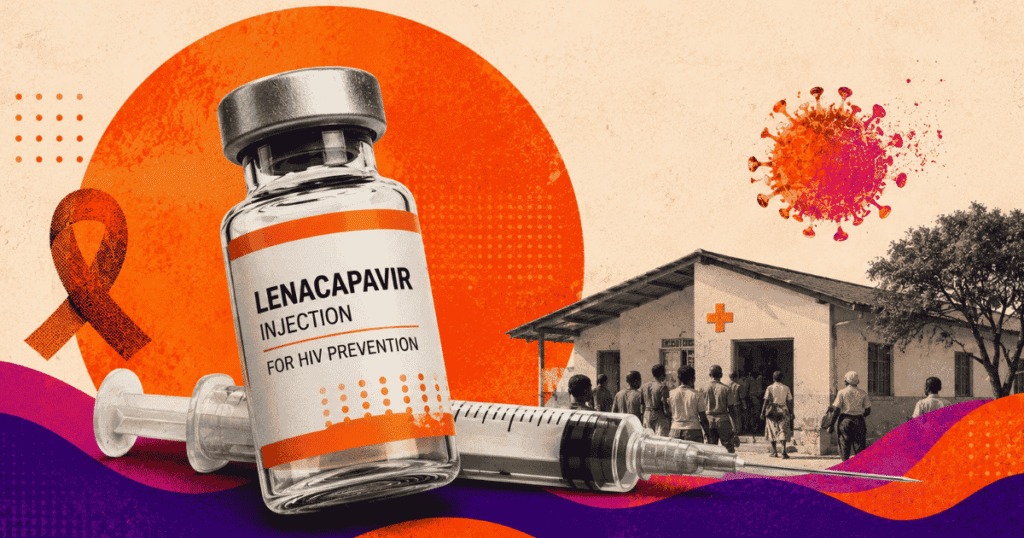

South Africa has the highest HIV burden in the world. Around 8 million people are living with the virus, and roughly 160,000 to 170,000 new infections are recorded every year.
On 5 June 2026, President Cyril Ramaphosa stood before a crowd in Secunda, Mpumalanga, and launched what he called a turning point in that story.
The medicine is Lenacapavir, known as LEN.
Lenacapavir: What you need to know
Lenacapavir is a six-monthly anti-HIV injection that prevents getting HIV through sex, and it is now stocked for free at 360 government clinics in six provinces.
Together with government funding, a partnership between the South African government, the Global Fund, and the Children’s Investment Fund Foundation will contribute R1.3 billion towards the rollout of lenacapavir.
That is roughly $72 million.
How it works
LEN is a capsid inhibitor. It interferes with HIV’s protective shell in a way that prevents the virus from getting into a person’s CD-4 immune cells. It is injected into the fatty layer of the abdomen once every six months and leaves a slow-release depot under the skin that delivers protection over that period.
The results from clinical trials are close to remarkable. A July 2024 study among teenage girls and young women showed near-perfect protection.
A second study, published in November 2024, showed a 96% reduction in new HIV infections among gay and bisexual men, transgender people, and others who took LEN.
It is not a vaccine. Unlike vaccines, which train the immune system to fight infections, LEN only works for as long as someone takes it. An easy way to understand it is to compare it to contraception: protection only lasts for the period you are covered.
Who can access it now
The 360 clinics currently stocking LEN are spread across
- Gauteng (133),
- KwaZulu-Natal (94),
- the Eastern Cape (49),
- Mpumalanga (31),
- North West (31) and
- the Western Cape (22).
The Northern Cape, Limpopo and the Free State will receive doses next year, when cheaper generic versions become available.
To access LEN at a government clinic, go to the HIV services section. A nurse or counsellor will explain the medicine, test you for HIV, and give you the option of LEN or a daily prevention pill. You must be HIV negative and weigh at least 35kg.
LEN is not yet available in the private sector. Gilead Sciences, the maker of LEN, has not registered a private sector price in South Africa. Private availability will likely only follow once generics reach the market in 2027.
The scale of what’s needed
The Global Fund has committed just under one million branded doses over two years (enough for around 456,360 people). But Wits modelling scientists estimate that between one and two million HIV-negative people need to take LEN at least once per year between now and 2043 for South Africa to end AIDS as a major public health problem.
The total number of doses needed over that period is between 18 and 36 million. Ramaphosa’s stated ambition is to reach close to one million people by the end of 2027, and three million people over the next three years.
The generic version of LEN is expected to become available in 2027 at a cost of around $40 per person per year (R660, at the time of publishing). At that price, and at the scale needed, local manufacturing stops being aspirational and becomes necessary.
SANAC has already called on local pharmaceutical companies to submit proposals.
South Africa approved lenacapavir through SAHPRA in October 2025, becoming the first African regulatory authority to do so.
The doses are here and the clinics are ready. The question now is whether the funding and the political will (along with all it’s red tape nonsense and logistics) can keep pace with the science.
ALSO READ: Don’t panic…. But there’s probably poop on your toothbrush