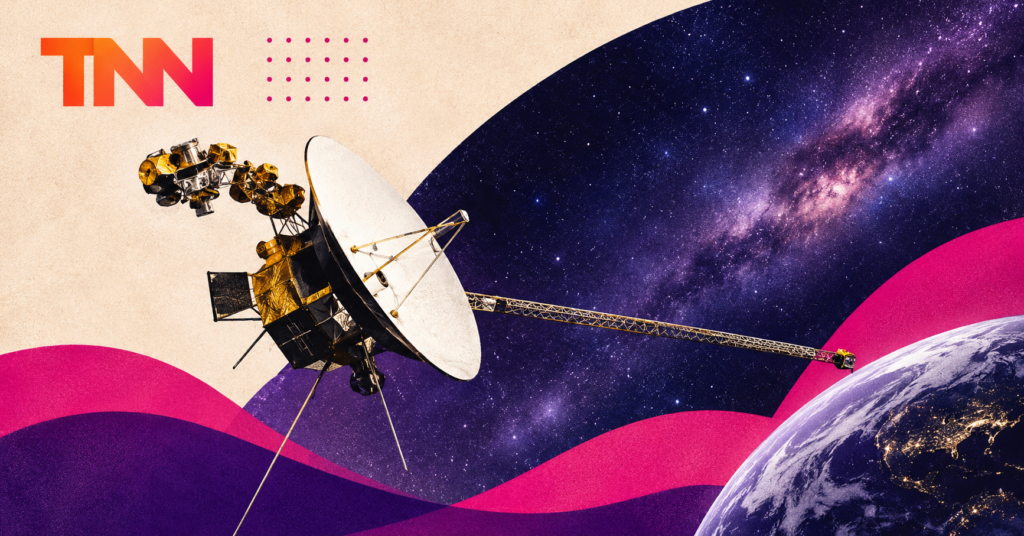

NASA’s Voyager 1 spacecraft stopped transmitting a detectable radio signal on 18 October 2026, missed a second scheduled contact window on 19 October, then resumed communications on 20 October without any recovery command from the ground[1].
Engineers at NASA’s Jet Propulsion Laboratory (JPL) confirmed the signal had returned, but the cause of the interruption remains under investigation.
The blackout lasted roughly 48 hours. It was the first incident of its kind in Voyager 1’s 49-year history.
What the fault protection system does
When Voyager 1’s onboard computers detect an anomaly, a built-in fault protection protocol directs the spacecraft to pause normal operations and place itself into a stable, safe configuration.
It gives engineers time to diagnose the problem and transmit a recovery plan. In this case, the spacecraft resolved the situation before any such plan was needed.
Diagnostic data retrieved after contact resumed showed that a group of primary thrusters had gone offline and backup thrusters had taken over automatically[2].
The thruster switch appears to be what triggered the fault protection response, but whether the thrusters failed because of a hardware problem, a software glitch, or some interaction with the September power-saving work is not yet established.
“This is the first time we’ve seen the spacecraft do something like this, but we are also at a point in the mission where we have to expect the unexpected,” said Kareem Badaruddin, Voyager mission manager at JPL.
The ‘Big Bang’ completed six weeks before
The timing is relevant. In early September 2026, JPL engineers switched off three devices aboard Voyager 1 and replaced them with lower-power alternatives. The procedure, called the Big Bang, was completed on Voyager 1 about six weeks after the same swap was carried out on its twin, Voyager 2.
The six devices involved serve a dual function: they consume power and they produce heat. Because Voyager 1 operates in interstellar space at temperatures far below zero, only by swapping all three pairs simultaneously could engineers reduce power draw while keeping heat distribution stable enough for the spacecraft to keep functioning.
The Big Bang was intended to push back the date at which NASA would have to shut down another science instrument. Without it, the mission would have needed to deactivate a further instrument on Voyager 1 as early as the northern hemisphere summer of 2027.
Whether the thruster anomaly and the Big Bang are connected is not confirmed.
How the power budget works
Voyager 1 runs on three radioisotope thermoelectric generators (RTGs), devices that convert heat from decaying plutonium-238 into electricity. At launch in 1977, the three RTGs together produced about 470 watts[3]. Both Voyager probes lose roughly 4 watts of output per year as the plutonium decays.
Four watts sounds trivial. On a spacecraft where every remaining load competes for a shrinking electrical budget, it is not.
The mission launched with 10 dedicated science instruments, some of which were switched off after Voyager 1’s planetary encounters in the early 1980s. In recent years the declining power budget has forced the team to deactivate two more.
On 17 April 2026, JPL engineers turned off the Low-energy Charged Particles experiment (LECP), which measured ions, electrons, and cosmic rays in interstellar space. That left two operating science instruments: a plasma wave subsystem that listens for electromagnetic activity, and a magnetometer that measures magnetic fields.
“While shutting down a science instrument is not anybody’s preference, it is the best option available,” Badaruddin said at the time of the LECP shutdown.
The Big Bang, completed in September, was designed to give those two remaining instruments more runway.
Communicating at the edge of the solar system
Voyager 1 is currently about 25.8 billion kilometres from Earth.
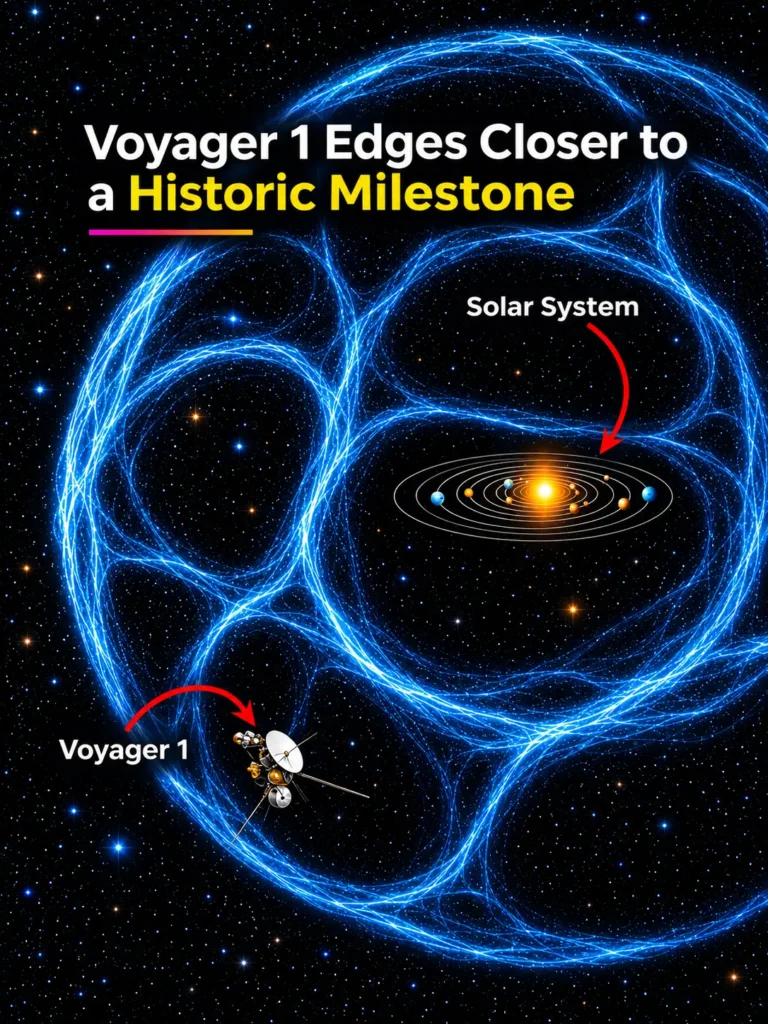
At that distance, radio signals travelling at the speed of light take roughly 23 hours and 52 minutes to arrive. A question asked in Pasadena takes two days to get an answer.
“If you want to say ‘hello’ to Voyager, you send your message and then you go home and you wait two days before you finally get a response,” said Suzanne Dodd, Voyager project manager at JPL.
That delay makes the fact that Voyager 1 recovered without ground intervention more significant, not less. By the time engineers registered the second missed contact window on 19 October, the spacecraft had already switched its own thrusters and stabilised.
18 November: one light-day
The blackout happened three weeks before a milestone that has been on the mission calendar for years. On 18 November 2026, Voyager 1 is projected to reach a distance of 16.094 billion miles (25.902 billion kilometres) from Earth, which is precisely one light-day, the distance light travels in 24 hours.
No human-made object has ever been this far from Earth.
It will take 49 years, two months, and 11 days to reach that mark from the moment of launch. At that point, every command sent from JPL will take a full 24 hours to arrive, and every response will take another 24 hours to return.
Voyager 1 will not detect any physical change as it crosses that threshold. The significance is entirely on the human side of the equation.
What today does not show
NASA has not identified the root cause of the thruster anomaly, and the agency has not confirmed whether the fault is linked to the September Big Bang procedure. The October blackout is described in NASA’s October 29, 2026 operations update as a “brief communications pause” and is treated as a data point in an ageing spacecraft’s behaviour, not as a sign of imminent mission end.
The October incident also does not tell us how much operational life remains. With the Big Bang complete on both Voyager probes, current engineering estimates suggest at least one science instrument on each spacecraft could keep operating into the 2030s. Those estimates are contingent on no further unexpected power draws or hardware failures.
Voyager 1 travels toward the constellation Ophiuchus at approximately 61,000 kilometres per hour. It will be silent well before it arrives.
Sources:
[1] NASA Jet Propulsion Laboratory. “NASA’s Voyager 1 Conserves Power, Resolves Brief Communications Pause.” NASA Science, Oct. 29, 2026.
[2] Shaikh, Kaif. “Farthest Human-Made Object in Space Loses Contact, Goes Nearly One Light-Day Away From Earth.” Interesting Engineering, Oct. 31, 2026.
[3] Mammana, Dennis. “Farewell, Voyager!” Stargazers, Creators Syndicate, Nov. 3, 2026.