
Uranus MB² is the sphere hiding inside a new kind of mobile tower antenna.
Picture a mobile tower with a crowd of dishes bolted to it. Each dish talks to one other site and nothing else.
At Africa Tech Festival in Cape Town, Huawei showed off a way to thin that crowd. The Uranus MB² is a single antenna that can point in up to ten directions at once.
Why towers get so crowded
Not every mobile site has a fibre cable running to it.
At the stand, Huawei’s Principal Marketing Manager at Huawei in South Africa, Nimrod Smit, explained that telcos still need microwave links for some remote sites.
Microwave here means a radio link. It beams data from one site to the next without a cable. Huawei says microwave carries the traffic for more than 60% of the world’s base stations.
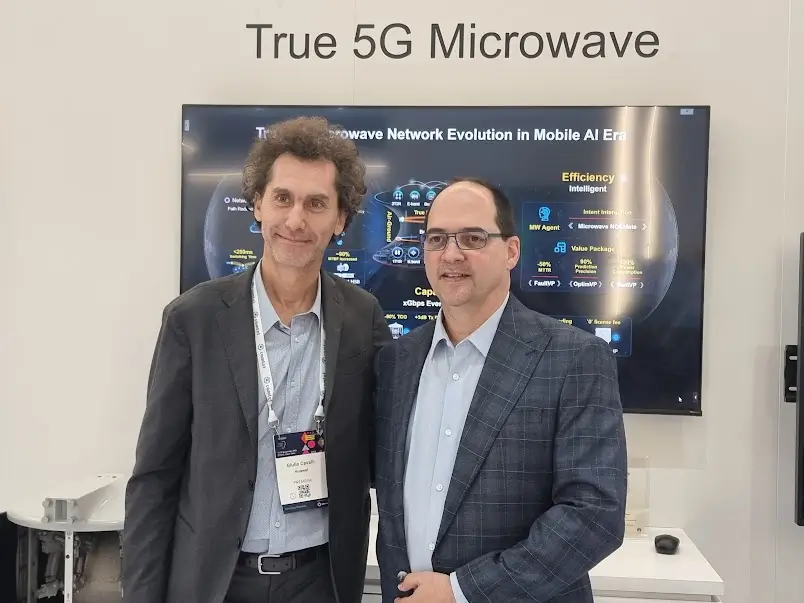
Giulio Cavalli, a networking engineer and a senior microwave expert at Huawei, took over from there. He’s from Italy, where Huawei has an R&D team. He said Huawei puts a lot of innovation into microwave.
Networks today have a lot of fibre. Many microwave links connect at a fibre point of presence, which makes a hub, he said. One site with many links.
The old rule was one link per dish. Cavalli summed it up as “one antenna, one link, one direction.” Every new link adds another dish, which adds weight and takes up space.
ALSO READ:
A ball that bends radio beams
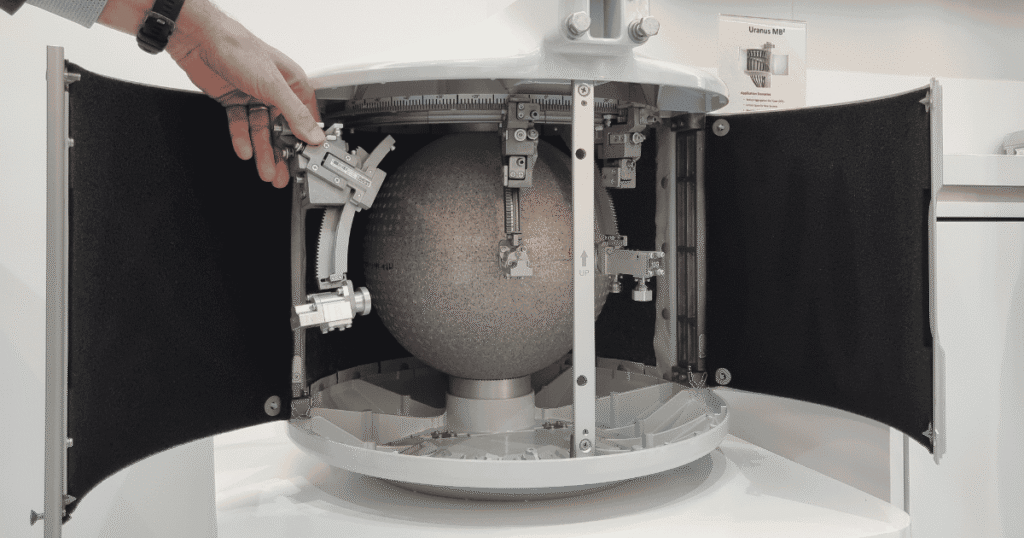
Inside the Uranus MB² cylinder sits a sphere which Cavalli said is built from several layers of specialised, lightweight dielectric materials. These are essentially electrical insulators that can be polarised by an applied electric field.
The signal arrives from the transmitter through a waveguide, a channel that carries it in. Huawei says the sphere is a Luneburg lens. It bends signals fed in at different points on its surface and focuses each one into a narrow beam.
Think of a torch with a lens on it. Each feed on the sphere works like its own torch, and each one lights up a different direction.
The demo model at the Huawei booth at Africa Tech Festival had three feeds fitted but Cavalli said you can add more, up to ten even. Each feed gives one beam in one direction.
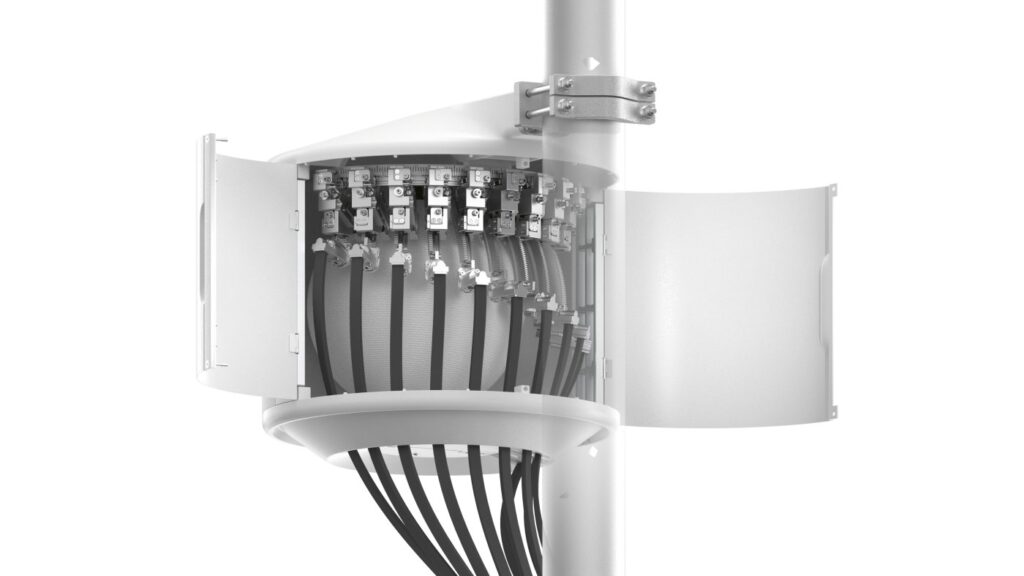
Huawei says each feed can be adjusted across 120 degrees sideways and 15 degrees up or down. Adding a direction only needs a new feed for that band. A band is a slice of radio spectrum, and this antenna handles eight of them, from 13 GHz to 38 GHz.
Huawei also says installing and aiming the antenna drops from three hours to 20 minutes.
What it could save
Huawei says one MB² can cut the antennas a site needs by up to 90%, shrinking the footprint and the load on the tower. It also trims rental costs.
The display card promises lower tower OPEX, which means the cost of running a site. It also talks about freeing up space for new services.
Software plays a part too. When several links on one site share the same radio band, they can interfere with each other. Huawei says its interference cancellation algorithm cuts the angle needed between those links from 90 degrees to 15 degrees.
The result, it says, is up to four times more spectral efficiency. That’s a measure of how much data fits in the same slice of spectrum.
More than phone towers
Cavalli said businesses can use it too. For example, security cameras. And stadiums that need to collect data.
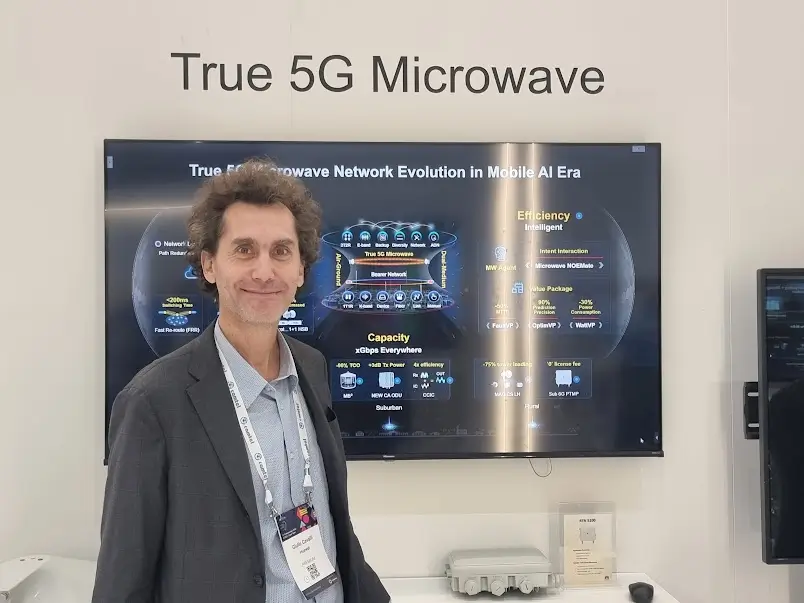
He compared it to point to multipoint, where one antenna serves many sites. In a typical setup like that, the sites share resources. Here each beam gets dedicated resources, so capacity stays fixed.
Range depends on the frequency, and about 15 kilometres is the furthest, for this specific antenna. For longer hops, Huawei has point to point solutions with bigger antennas.
Cavalli said those have passed 150 kilometres. If you need more distance, he said the MB² isn’t the one to pick.
Is it available yet?
Yes. Cavalli said it’s already a GA product, which means generally available.
Huawei says it has been validated in more than 10 networks worldwide, and it won a 2026 Red Dot Design Award. The statement from the jury read: The sophisticated and elegant form of the MB² Antenna allows for efficient installation and adjustment in dense infrastructures.
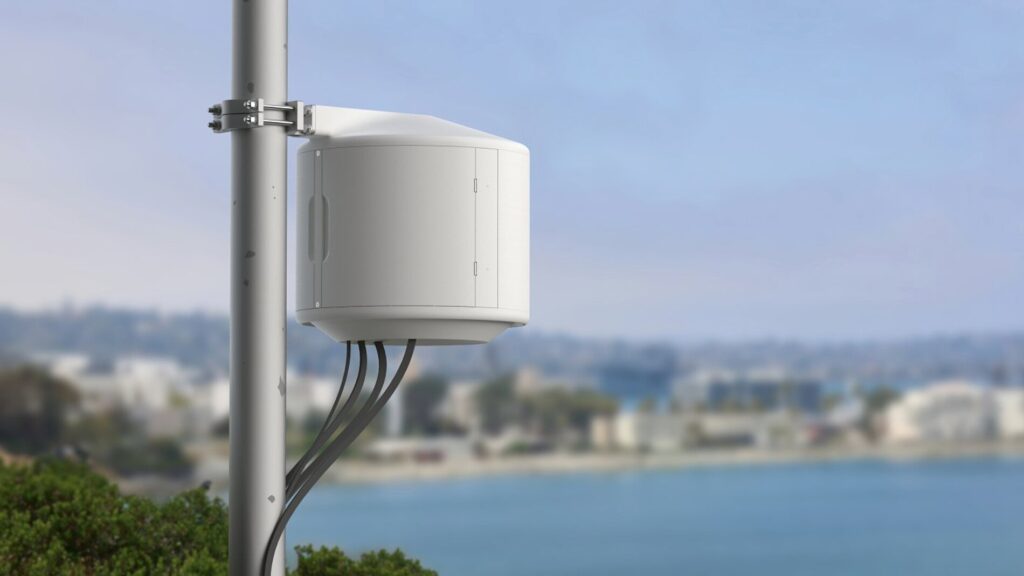
The outside got some thought too. A cone-shaped top stops water pooling and birds nesting. Cavalli called the concept “unique in the market.”
So next time you pass a mobile tower, count the dishes. Could ten of them become one?
References
- Cavalli, Giulio. Recorded interview by Cheryl Kahla. Africa Tech Festival, Cape Town, November 19, 2026.
- Huawei. “Enterprise Microwave,” Huawei Enterprise. Accessed November 21, 2026.
- Huawei. “Huawei’s MB2 Antenna Wins 2026 Red Dot Design Award,” Huawei News, July 30, 2026.
- Huawei. “Huawei’s MB² Solution Enters Commercial Phase Delivering 4x Spectrum Efficiency and 90% Antenna Number Reduction for Hub Sites,” Mobile World Live. Accessed November 21, 2026.
- Huawei. “Microwave Enters into a New Era: Innovation Enables a 10 Years Smooth Evolution towards 5G,” Mobile World Live. Accessed November 21, 2026.