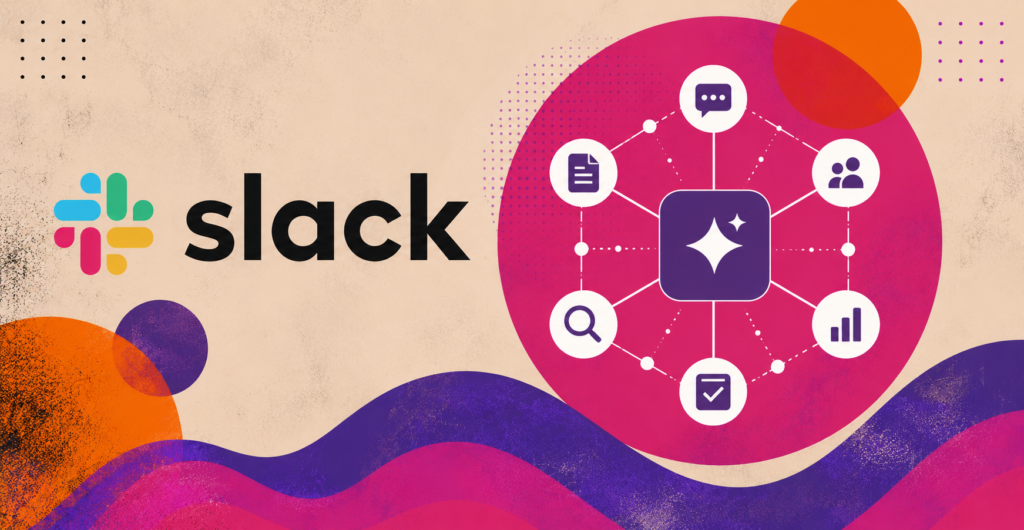

Slack’s Slackbot has grown up to become a whole operating system. That was the central message at the Salesforce Agentforce World Tour session in Johannesburg on Tuesday, delivered by Chris Roberts, Regional Vice President at Slack.
Roberts warned that throwing AI at broken ways of working is not going to magically fix them. In some cases, it could make the mess even worse.
The Slack AI upgrade
A few years ago, companies not having access to AI tools was a real issue. This is not the case anymore. Today, the issue is work scattered across too many systems and platforms.
Adding even more tools into that mix just creates chaos at a much faster speed.
His argument was that Slack, rebuilt around AI agents, changes the structure itself.
The problem Slack can solve
According to a 2023 Gartner Digital Worker Experience Survey, 47% of employees struggle to find critical data or information. In addition, LSA Global research on organisational alignment found that poorly aligned teams generate 72% less profit.
Roberts described it as a complete rethink of how people work with data and communicate with teams. Even how companies are using software in the first place.
He said the difference is context.
The AI built into the new Slack understands your role, your priorities, your projects, even the way you work.
What the new Slack actually does
The repositioned Slack operates as a single conversational interface. One search bar and one process where you can ask anything and find everything. You can access documents or take actions without even leaving the app.
Enterprise Search connects to Google Drive, Teams, OneDrive, SharePoint, Jira, Confluence, GitHub, Asana, Box, Dropbox, Gmail, Outlook, and Notion.
Internal wikis and on-premises systems can also surface through a custom API. The aim is to end the tab-switching problem that Salesforce says cuts productivity by 40%.
On third-party agents:
Slack is also not locked to Agentforce.
Third-party agents can work inside Slack too, which is important for companies that are not fully embedded in the Salesforce ecosystem.
It is a surprisingly open approach from a company that could easily have pushed customers deeper into its own stack.
The productivity figures shared during the event all come from Salesforce’s own data.
The company claims overall productivity increases of 47%, alongside a 36% improvement in sales win rates. These include:
- Service teams resolving issues 32% faster.
- Marketing productivity improving by 37%.
- IT teams saving 36% through automation.
- Finance teams making decisions 36% faster.
- HR reporting a 37% increase in employee engagement.
Slackbot gets a serious upgrade
The most tangible product change is Slackbot.
It is being rebuilt as an always-on employee agent that already knows your work context and can take action across connected systems without setup.
The feature set includes scheduling meetings, email and Salesforce actions, voice commands, automated workflows, and intelligent note-taking during meetings.
The desktop version monitors your screen and acts on what it sees.
Slackbot can also route tasks to specialised agents, whether Agentforce agents or third-party AI, and coordinates the response.
New features being highlighted alongside this include Recap, a Today page, and calendar integration in the Today view.
These are the more everyday UI changes sitting beneath the bigger agent architecture.
The infrastructure
Salesforce calls the full stack the Agentic Enterprise Architecture. Slack sits at the engagement layer.
Below it: Agentforce for customer and employee agents, Customer 360 covering sales, service, marketing, and commerce, and Data 360 pulling together Informatica, MuleSoft, and Tableau.
The model layer supports OpenAI, Anthropic, Google Gemini, Meta’s LLaMA, and open-source alternatives. MCP and A2A are the protocols for connecting external agents.
Roberts described this as the OS that makes the agentic enterprise possible. Not a product feature, instead it’s the underlying architecture.
The client roster shown included AWS, Accenture, NASA’s Jet Propulsion Laboratory, OpenAI, Anthropic, Duolingo, Perplexity, and Rivian.
Philip Hess, CEO of reMarkable, was quoted on the slide: “You start with Slack as a tool. Then you realise it’s how you run the company.”
For South African enterprises already invested in the Salesforce ecosystem, the integration argument is strong.
For those who are not, the case is thinner. But the direction is clear: Salesforce wants Slack to be where work actually happens, and Tuesday’s session was a detailed argument for why they think they can pull that off.