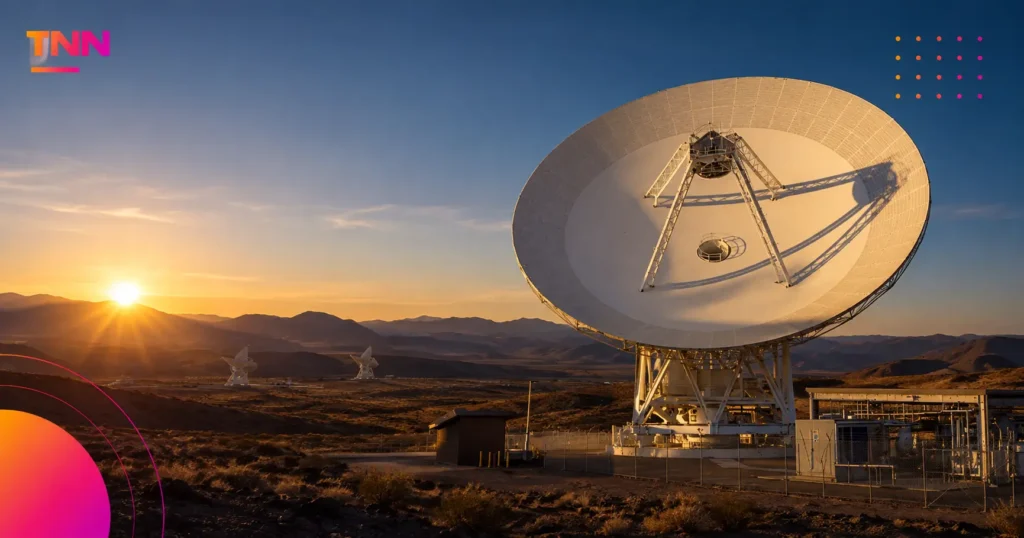

A radio signal from Voyager 1 takes more than 22 hours to reach Earth. When it arrives, it’s faint enough to get lost in static. The reason it doesn’t is a global chain of giant dish antennas called the Deep Space Network (DSN), managed by the NASA Jet Propulsion Laboratory (JPL) in Southern California.
That chain just got a new link. NASA’s Goldstone Deep Space Communications Complex, near Barstow in the Mojave Desert, commissioned its newest antenna on 3 August 2026, when Deep Space Station 23 (DSS-23) tracked the Chandra X-ray Observatory for the first time.[1]
A ribbon-cutting ceremony followed on 25 August.
DSS-23 is a 34-metre-wide (114-foot-wide) multifrequency beam-waveguide antenna, the fifth of six new dishes planned under the DSN Aperture Enhancement Project, which began in 2009.[2]
What a beam-waveguide antenna actually does
The design is worth understanding, because it’s not obvious why a dish this sophisticated looks the way it does.
In a conventional radio antenna, the sensitive electronic receiving equipment sits on the dish itself, moving with it as it tracks a spacecraft across the sky. That creates problems: the receiver is exposed to temperature swings and vibration, and any maintenance requires working on a moving structure tens of metres in the air.
A beam-waveguide antenna solves this by using a series of mirrors to guide incoming radio signals down from the dish into a stable, climate-controlled underground room, where the sensitive electronics sit stationary. That design allows engineers easy access for maintenance and upgrades without taking the antenna offline.
The signal path itself runs through a quadripod, a four-legged support structure at the centre of the reflector dish.[3] The quadripod weighs 16.5 tonnes and carries a curved subreflector that bounces radio frequency signals from deep space off the main reflector and down into the antenna’s pedestal, where the receivers are housed.
The result is a dish that can operate across multiple radio frequency bands in the same session, switching between missions without swapping hardware.
What DSS-23 joins
The DSN has operated since 1963 and currently supports more than 40 spacecraft exploring the solar system and interstellar space, among them Voyager 1, Voyager 2, and New Horizons. It runs three complexes: Goldstone in California, a facility near Madrid in Spain, and one near Canberra in Australia. Each complex anchors its operation around a single large 70-metre (230-foot) dish, supported by several smaller 34-metre dishes.
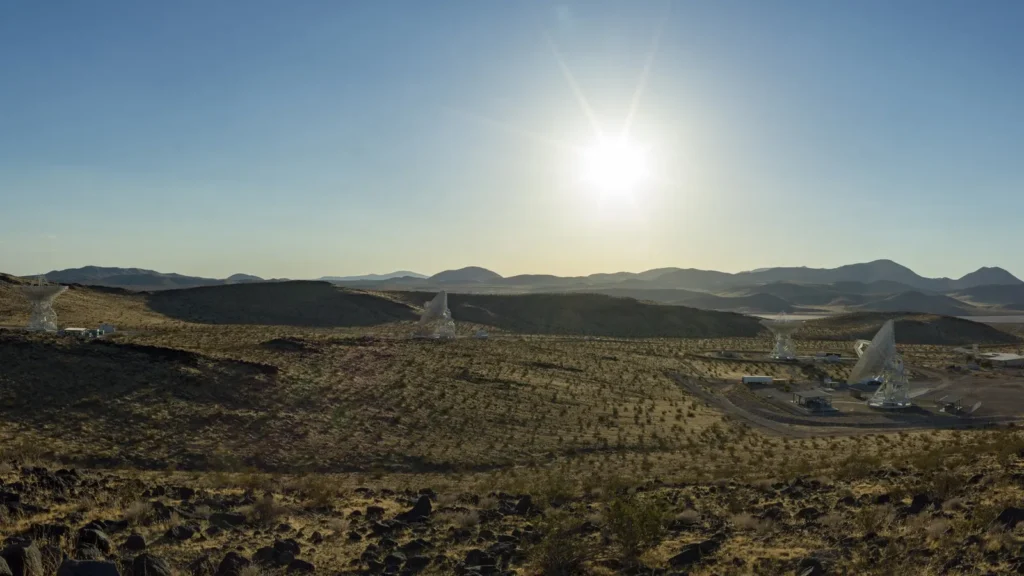
DSS-23 is the fifth antenna at Goldstone, joining three existing 34-metre dishes, DSS-24, DSS-25, and DSS-26, and the 70-metre DSS-14.[4] A panorama released by NASA in August 2026 also shows the site’s retired 26-metre Apollo Antenna, built in 1967 for the Manned Space Flight Network, which is no longer operational.
The new dish has already been communicating with active missions. Since coming online, DSS-23 has contacted NASA’s Mars Reconnaissance Orbiter, Psyche, Juno, and Voyager 1, among others.
ALSO READ: NASA is peering into Uranus and it’s personal this time
The constraint the new dish does not fix
The ribbon cutting is the good news. The harder news sits alongside it.
Brad Arnold, DSN manager at JPL, has said publicly that despite ongoing construction, the network cannot keep pace with current demand: “We’re trying to add capacity and more antennas, but we can’t keep up with the demand that’s currently out there, so missions should expect to be getting less availability.”
Arnold also flagged the Artemis crewed lunar programme as the network’s biggest single pressure point: “That ultimately will affect our ability to service the rest of the missions,” he said, describing Artemis as “the gorilla in the room” because crewed missions are prioritised over robotic spacecraft by default.
That priority has already had practical consequences. Communications with the uncrewed Artemis 1 mission in 2022 and the crewed Artemis 2 mission in 2026 both took precedence as they travelled around the Moon, substantially reducing capacity for everything else on the network.
NASA managers had been warning of this gap since at least 2021. The problem is structural: demand from international space agencies using the DSN has also grown considerably over the past five decades, and the Aperture Enhancement Project, for all its progress, will not finish until 2029.
The engineering challenge behind the construction
Germaine Aziz, manager of the DSN Aperture Enhancement Project at JPL, put the difficulty plainly after DSS-23 reached operational status.
“The biggest challenge wasn’t actually constructing the antenna. It was transforming a complex collection of mechanical, electrical, software, radio frequency, and infrastructure systems into a single, mission-ready asset,” Aziz said.
James Kenyon, associate administrator of the Research and Technology Mission Directorate at NASA Headquarters, framed the stakes at the ribbon cutting.
“By expanding the Deep Space Network, we are strengthening the communications foundation NASA needs for the bold missions ahead, from exploring more of the Moon than ever before to peering deeper into the solar system,” Kenyon said.
What this study does not show
DSS-23’s commissioning confirms added capacity at one complex. It does not establish whether that capacity closes the overall network deficit Arnold described. The Aperture Enhancement Project is designed to deliver six new antennas across all three complexes, bringing the total number of 34-metre dishes network-wide to 13 once DSS-33 comes online at Canberra. That final antenna is not expected before 2029.
The 34-metre dishes also carry a secondary function the 70-metre dishes no longer reliably provide. After more than 50 years of near-continuous operation, the network’s ageing 70-metre antennas are increasingly costly to maintain. The newer 34-metre dishes can be arrayed together, combining their signals to back up a 70-metre antenna if needed.
The network’s own numbers tell the rest: at times, demand on the DSN has exceeded capacity by more than 40 per cent. A single new dish in the Mojave does not change that ratio.[5] It is one fewer gap in a network that, by its own management’s account, has run short of headroom for years.
Sources:
[1] NASA/JPL. “NASA Deep Space Network’s New Goldstone Antenna Goes Online.” NASA Science Photojournal, Aug. 2026.
[2] NASA/JPL. “New Next-Gen Dish Adds Muscle to NASA’s Deep Space Network.” NASA Jet Propulsion Laboratory, Aug. 2026.
[3] NASA/JPL. “Deep Space Station 23: Goldstone Antenna Gets Its Giant Reflector.” NASA Science Photojournal, Dec. 20, 2024.
[4] NASA/JPL. “Panorama Showcasing the 34-Meter Antennas of the DSN’s Goldstone Complex.” NASA Science Photojournal, Aug. 2026.
[5] Edwards, Bernard L. “Addressing High-Rate Communications in NASA’s Space Technology Mission Directorate’s Envisioned Future.” NASA Technical Reports Server, June 2025.