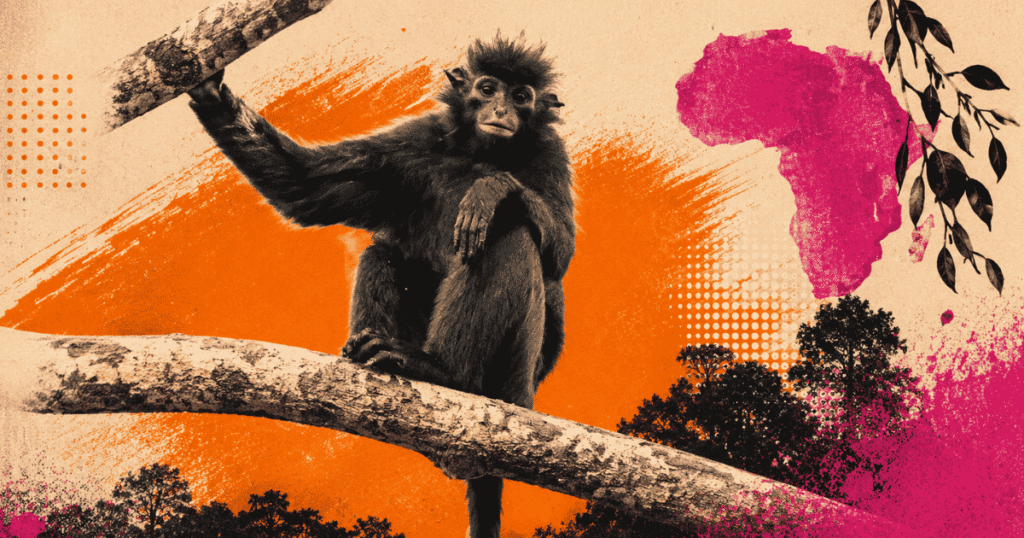

Scientists in DRC confirm new monkey species after blurry 2008 photo and 18 years of fieldwork. This is Likweli.
A team of researchers photographed an unidentified black monkey in the canopy of what is now Lomami National Park in 2008 and then lost track of it for a decade. What they eventually confirmed, published on 15 July 2026 in the journal PLOS One, is the fifth new species of African monkey formally described in the past 75 years[1].
New monkey species confirmed
The species is called Colobus congoensis. Its common name, Likweli, comes from the Balanga communities living west of the Lomami River in the Democratic Republic of Congo (DRC). The Mituku communities to the east had their own name for it: kasaba nkoni, meaning “the branch shaker.”
Both names suit it. Likweli weighs roughly 7 kilograms and stretches around 1.2 metres from its nose to its tippy tail. It is mostly black, with spiky fur, an orange-cream patch of bare skin around the mouth and nostrils, a grey mask around the eyes, and a white patch under the tail.
The study was led by John Hart of the Lukuru Wildlife Research Foundation, with co-corresponding authors Junior Amboko, a conservation biologist and PhD student at Florida Atlantic University (FAU), and Kate Detwiler, an associate professor of biological sciences at FAU. Researchers from Yale University, the City University of New York, and the Frankfurt Zoological Society also contributed.
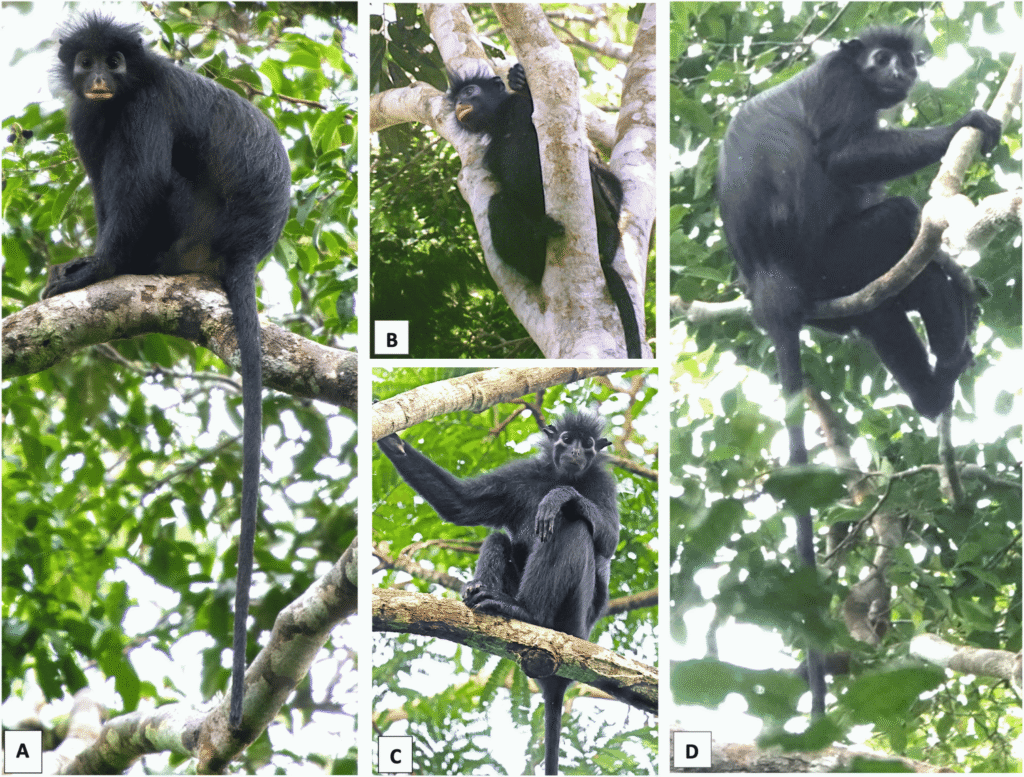
When it roars, its lips form a pale orange O. The roar itself has been compared to a frog and a pig snorting at the same time. There is a US presidential joke in here somewhere but we, at TNN, are better than that….
How the case was built
The first photograph in 2008 was too blurry to do much with. Nothing more was documented until November 2018, when Congolese field researcher Jean Pierre Kapale of the Lukuru Wildlife Research Foundation photographed a black monkey with pale facial markings during a surveillance patrol.
Over the next ten months, Kapale’s team recorded the animal seven more times.
From 2018 to 2022, the full research team logged 114 field observations across an estimated range of approximately 1,700 square kilometres in Lomami National Park and its buffer zone, in highland forest between the Tshuapa, Lomami and Lualaba river tributaries[2].
To go from “unusual monkey” to confirmed new species, the team needed physical specimens. Park rangers confiscated three dead monkeys, two females and one male, from hunters. Those specimens allowed researchers to study skeletal anatomy, skull morphology, and to extract DNA.
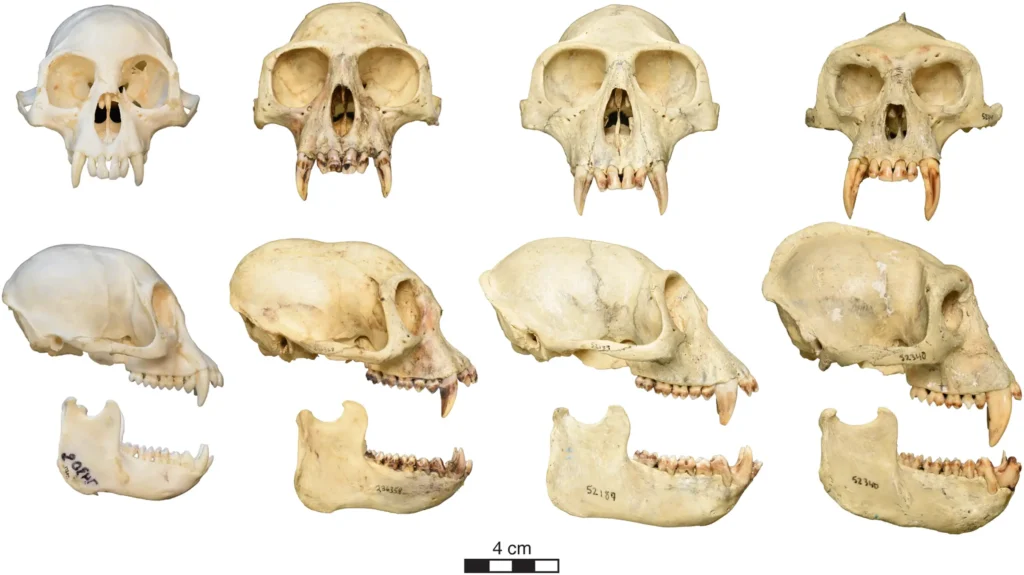
Julia Arenson, a postdoctoral fellow at Yale and co-author of the study, had assembled one of the most comprehensive comparative datasets on colobus monkey anatomy available. The team compared Likweli’s skulls and pelts against museum collections of every known African colobus species.
Christopher Gilbert, professor of anthropology at the CUNY Graduate Center and Hunter College, described the bar that had to be cleared: “When a potential new species is discovered, the evidence has to be overwhelming. We analyzed museum collections and comparative datasets, examining skulls, pelts, and skeletal anatomy alongside specimens from known African colobus monkeys. Those comparisons allowed us to demonstrate conclusively that Colobus congoensis represents a distinct species”.
The researchers also recorded and analysed Likweli’s vocalisations. Its calls resemble those of other colobus species in some respects but are acoustically distinct in sequence and frequency.
Detwiler described the genetic finding as a shock: “We were shocked with the genetic data because it gave us such a signal of deep divergence”.
That divergence is substantial. Likweli’s closest known relative is the black colobus (Colobus satanas), a species that lives more than 1,200 kilometres away in west-central Africa. The genetic analysis estimates the two species split from a common ancestor roughly 4 to 5 million years ago, which is the deepest known evolutionary split within the entire Colobus genus.
Along with anatomy and genetics, the team used local knowledge. Researchers interviewed residents of 52 villages bordering or located within Likweli’s range. Only eight of those villages had anyone who could identify or describe the monkey.
The researchers note in the paper that this matters: the same communities have extensive knowledge of other local primates. Likweli’s near-total absence from local awareness is not a gap in the communities’ knowledge, it is evidence of just how restricted and rare the animal is.
“Our team evaluated multiple datasets that all reached the same conclusion: Likweli is a distinct species of Colobus monkey we haven’t seen before,” said Arenson.[2]
What the study does not yet show
The paper establishes that Colobus congoensis is a distinct species. It does not yet establish population size, diet, reproductive behaviour, or the full extent of the animal’s range. The 114 field observations represent a strong baseline but were concentrated over four years in a single, difficult-to-survey area. The researchers note that further surveys, dietary research, and full genome analysis are still needed.
Likweli is confined to tall, closed-canopy forest growing on deep clay soils inside Lomami National Park and a narrow buffer zone.
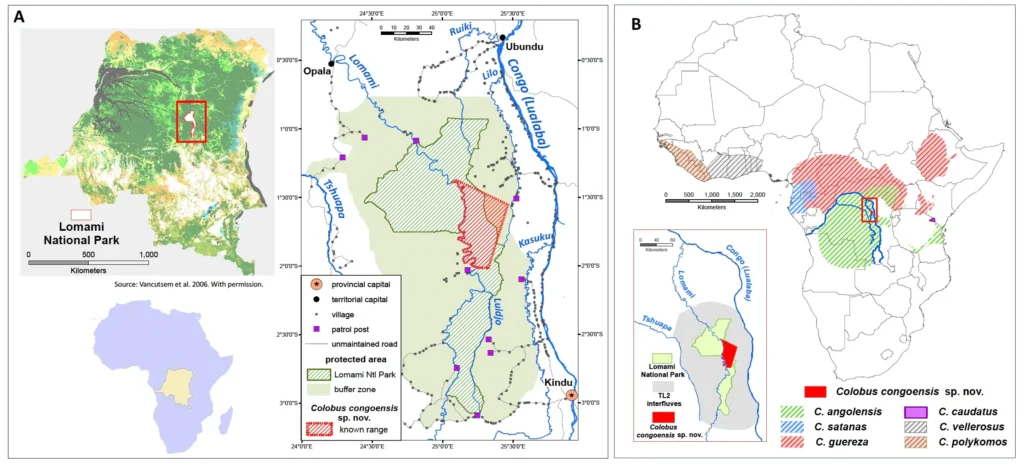
It lives alongside at least eight other primate species, including the bonobo. The study does not determine why it is restricted to this specific forest type or why the split from Colobus satanas produced two populations so geographically distant from each other.
The conservation status the paper recommends
The study formally proposes that the International Union for Conservation of Nature (IUCN) classify Colobus congoensis as Endangered.
The reasoning: an estimated range of 1,700 square kilometres is small by any measure, the known population lives mostly inside a single national park, and hunting pressure alongside expanding human settlement at the park’s margins is already documented.
At least 15 new villages appeared within or near the species’ range between 2015 and 2023. The holotype, the adult male skin and skeleton that formally anchors the species’ scientific description, is held at the Yale Peabody Museum.
Eric Sargis, professor of anthropology at Yale, curator of mammalogy at the Yale Peabody Museum and director of the Yale Institute for Biospheric Studies, was direct about what the finding implies:
“This is a rare discovery with significant conservation implications. Our analyses provide strong evidence that this is a distinct new species that is endangered”.
Lomami National Park, the 8,874-square-kilometre park that contains most of Likweli’s known range, was itself created in part because of an earlier discovery from the same region. The Lesula (Cercopithecus lomamiensis), a monkey found nearby in 2007 and formally described in a PLOS One study in 2012, prompted the park’s establishment. Several researchers on the Lesula study are co-authors on this one too.
Hart acknowledged the team that made the 2026 finding possible:
“The discovery and documentation of the Likweli never would have happened without our team of Congolese explorer naturalists. These field leaders recognized when they were in front of something they did not know”.
Sources
[1] Hart, John A., et al. Likweli: A remarkable new species of Colobus monkey from the Lomami National Park, Democratic Republic of Congo. PLOS One, July 15, 2026.
[2] Cummings, Mike. Meet ‘Likweli’: A new monkey species discovered in the Congo Basin. Yale News, July 15, 2026.