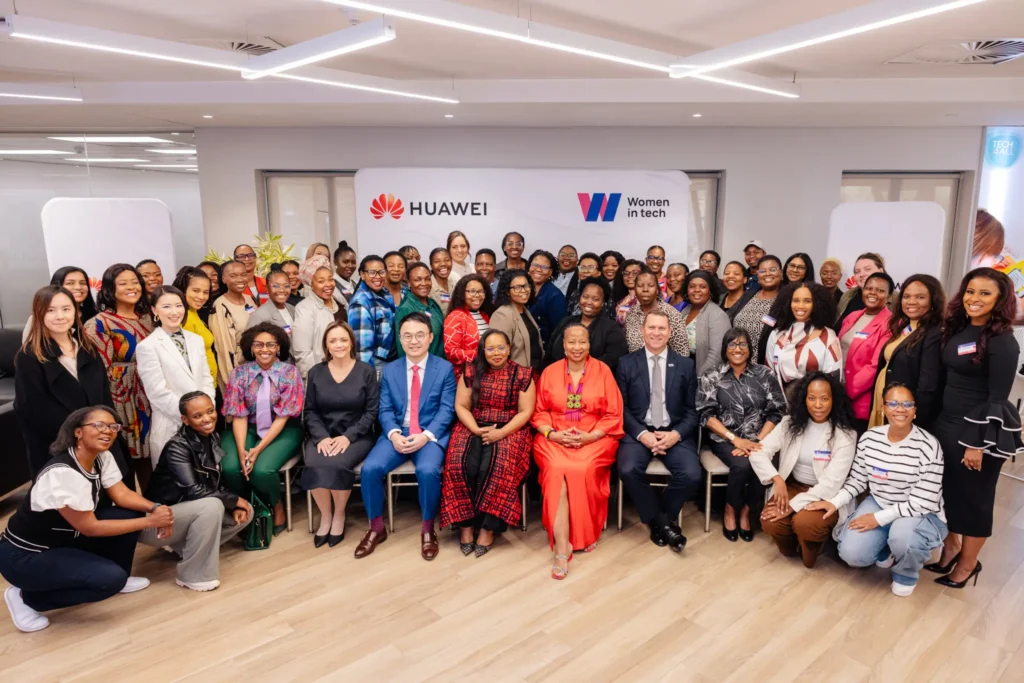

Huawei South Africa has launched the sixth edition of its Women in Tech Digital Skills Development Programme, gathering 50 businesswomen and public-sector leaders for a three-day immersive experience centred on technology, leadership, and enterprise growth.
This year’s theme, HERabytes: Small Business. Big Intelligence, signals a sharp focus on equipping women entrepreneurs with the tools to harness AI for real-world impact.
At the opening event, representatives from Huawei, the Department of Communications and Digital Technologies (DCDT), the Department of Women, Youth and Persons with Disabilities (DWYPD), and Henley Business School Africa spoke about the importance of giving women the skills and confidence to take their place in South Africa’s digital economy and shape its AI-driven future.
The programme puts that ambition into practice, with three days of hands-on training focused on the AI and digital tools women can apply in their businesses.
“Technology has value because of what people can do with it,” said Charles Cheng, Deputy CEO of Huawei South Africa. “Innovation becomes meaningful when it creates opportunity, strengthens businesses, and enables more people to participate in the economic possibilities technology creates. We want women entrepreneurs to be firmly part of that future.”
For Nonkqubela Jordan-Dyani, Director-General of the Department of Communications and Digital Technologies, participation means more than connecting people; it means ensuring they can turn technology into opportunities.
“An AI economy that excludes women will not reach its potential,” said Jordan-Dyani. “That potential sits right here. A digital economy that includes women is stronger, more innovative, more competitive and more resilient. Women must be recognised as the future leaders, the innovators and the creators.”
Women are already driving South Africa’s digital economy. They run businesses and create jobs every day. AI gives them new tools to build on that progress and find ways to grow. The opportunity is to make sure women are not watching this next technology shift from the sidelines.
“Women, young people and persons with disabilities must not only use technology. They must design it, maintain it, sell through it, build businesses around it and share in the income it creates,” said Shoki Tshabalala, Deputy Director-General at the Department of Women, Youth and Persons with Disabilities, speaking on behalf of Minister Sindisiwe Chikunga. “Women must be at the epicentre.”
“Artificial intelligence is accelerating what is possible,” said Christina Naidoo, COO of Huawei South Africa. “A small business can use AI to understand customers better, improve marketing, analyse information faster, forecast demand or automate work that once took hours. For South African women entrepreneurs, this is a rare opportunity. We do not have to arrive at the end of this technology wave and spend years catching up. We can be part of shaping it from the start.”
That opportunity builds on Huawei’s longer-term investment in digital inclusion. “Huawei’s Women in Tech sits within a much longer Huawei commitment to digital inclusion and skills development,” said Naidoo.
Through initiatives such as the Huawei ICT Academy and Graduate Programme, Huawei continues to build South Africa’s digital talent pipeline. More than 350 graduates have come through the Graduate Programme since 2017, alongside its global commitment to helping millions of women build digital skills.
The programme also recognises that building a stronger digital future means developing confidence and leadership, and the ability to adapt as technology changes.
“AI can help us work faster,” said Jacques le Roux, COO of Henley Business School Africa. “It can help us see patterns that we might otherwise miss. It can offer options, automate routine work, and open doors that were previously closed. But AI cannot decide who we want to be as leaders. It cannot choose our values. It cannot take responsibility for our actions.
Over three days, women running small businesses will learn how to use AI and other digital technologies for growth. Sessions also cover 5G-Advanced and cloud computing, followed by leadership development at Henley Business School Africa on 28 August.
“We look forward to seeing the businesses, the ideas and the leaders that grow out of this cohort, and to continuing this partnership until every woman who wants a place in South Africa’s digital economy has one,” said Jordan-Dyani.
ALSO READ: Huawei Connect 2026: How SA Can Scale AI Across Industries