
Your phone signal runs on electricity, so when the grid goes down, the network can go with it. But some cell towers are now learning to predict power cuts.
Izak Botha, Sales Product Manager for Wireless Telecom Energy at Huawei, gave a presentation to journalists at the Huawei booth at Africa Tech Festival in Cape Town. He opened by saying that “if there’s no power, there is no network.”
So what does a tower do when the lights go out? Botha explained how Huawei’s software helps a tower plan ahead for a blackout.
What a tower does when the grid fails
A typical tower site has grid power and batteries, and in most cases also a diesel generator. When the grid fails, the batteries take over. At 15% charge, the generator starts and refills them to 100%. Then it switches off.
That loop repeats until the grid returns. Botha said the generator burns fuel and needs regular maintenance, which adds to a site’s running costs (OPEX, in industry speak).
Draining a battery too far causes its own trouble, with Botha explaining deep discharges shorten a battery’s working life.
A tower that learns the pattern
Huawei’s answer is software called NetEco. It uses AI to study how much power the tower uses, and also tracks when the grid goes off and comes back.
After a few days or weeks of data, Botha said, the pattern shows up. Outages tend to repeat themselves, and because AI is good at pattern recognition, the software can forecast when the grid is likely to return and how much power the tower will need until then.
This now changes the generator’s job, because if the system expects the grid back soon, the battery doesn’t need a full charge. Botha gave 60% as an example. When the grid returns, it tops the battery up. He said that’s much cheaper than charging it with the generator. The generator switches off sooner, and the diesel bill shrinks.
An example shared at the booth covered a South African case of a site without hybrid power logic using 8,760 litres of fuel. A first upgrade, which Huawei calls iDiesel, cut that to 4,818 litres. The AI version, which Huawei calls adaptive fuel saving, used 1,971 litres.
Huawei says iDiesel holds the generator at 80% load for the best efficiency. It puts the AI version’s saving at 75% compared with a non-hybrid site. It didn’t say how long the period was or how many sites it covered.
The weather forecast joins in
The software also checks the weather. Nimrod Smit, Principal Marketing Manager at Huawei in South Africa, said NetEco connects to a weather service that looks seven days ahead. That lets it charge the batteries early. Huawei cited SolarGIS as the weather data source.
Botha said the tower uses solar power first and its batteries second. Grid power comes after that, and the generator is held back as the last line of defence.
What if the forecast is wrong? Botha said a sudden storm is fine. The generator switches back on, and the system hunts for savings again the next day. Keeping the signal up always comes first.
Using every bit of sun
Botha gave another example of a site that needs just 1 kilowatt of power but has 10 kilowatts of solar panels installed. All that extra capacity goes to waste.
So the battery covers the load first. When the sun is strong, the panels carry the load and refill the battery. So, the site buys less from the grid.
The panels are a one-time cost, he said, and the sun is free every day. This only works with a battery that can charge and drain many times.
Choosing what stays on
If an outage drags on, the tower can pick what to keep running. Power-hungry 5G can be switched off while 4G and 3G carry the traffic that matters most. The operator decides which equipment is a priority.
Smart breakers make this possible. In a normal setup, every load shares one power line and one battery. These breakers let a site cut individual loads one by one.
Botha said they can also be set in software to the amperage a site needs. So nobody has to swap breakers.
In a regional blackout, the same idea works across many sites at once. Non-priority equipment goes off, and the network stays up.
Botha also described switching some sites off as their batteries run low. Antennas on the sites that stay on can change their coverage.
ALSO READ: Uranus MB2: a mobile tower antenna with a clever back end
The battery behind it all
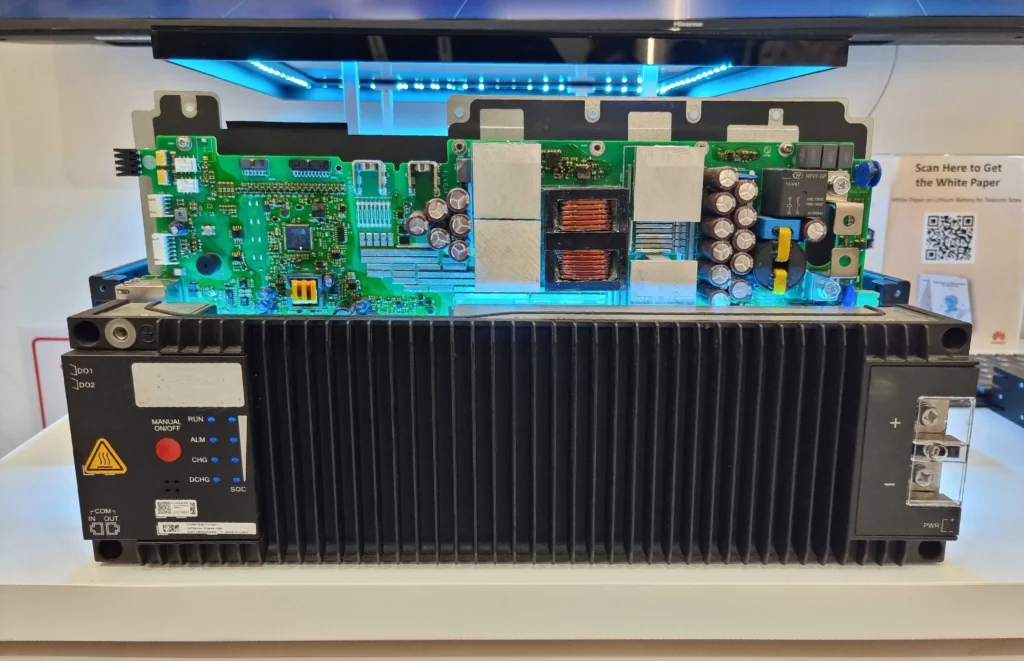
All of this leans on the battery. In March 2025, the International Telecommunication Union (ITU) and Huawei released a joint white paper on lithium batteries for telecom sites.
The paper favours lithium iron phosphate (LFP) batteries and describes them as highly stable in heat and long lasting. It also lists the dangers at tower sites, including water getting in and condensation.
It notes that most lithium batteries in the industry meet only a basic protection rating called IP20, and that insects and water can get in. It recommends stronger protection for the battery management system, the electronics that watch over the battery.
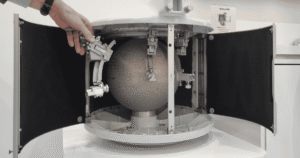
This was confirmed during the booth tour, with the battery placard listing waterproofing and insulation. It also mentioned crush and nail penetration tests.
What could come next
Botha said operators in Europe already push spare energy from their sites back into the grid. They think the same could work in South Africa.
A related idea is the virtual power plant. Batteries at many sites discharge at set times to feed the grid, and operators can sell that power.
The next time your signal holds through a blackout, a tower somewhere may have seen it coming.
This piece draws the presentation given at the Huawei booth. TNN checked the background facts against the ITU white paper. The fuel figures are Huawei’s, and we couldn’t verify them independently.
References:
- Botha, Izak. 2026. Presentation and interview transcript recorded by Cheryl Kahla. Huawei stand, Africa Tech Festival, Cape Town, November 19.
- Huawei. 2026. “High Quality Li Battery.” Display placard. Photographed at Africa Tech Festival, Cape Town, November 19.
- Huawei. 2026. “More Fuel Saving: Grid-Battery-D.G. Synergy, 50%+ More Fuel Saving” and “More Solar Harvest: iSolar3.0.” Display slides. Photographed at Africa Tech Festival, Cape Town, November 19.
- International Telecommunication Union and Huawei. 2025. White Paper on Lithium Batteries for Telecom Sites. Geneva: ITU.