

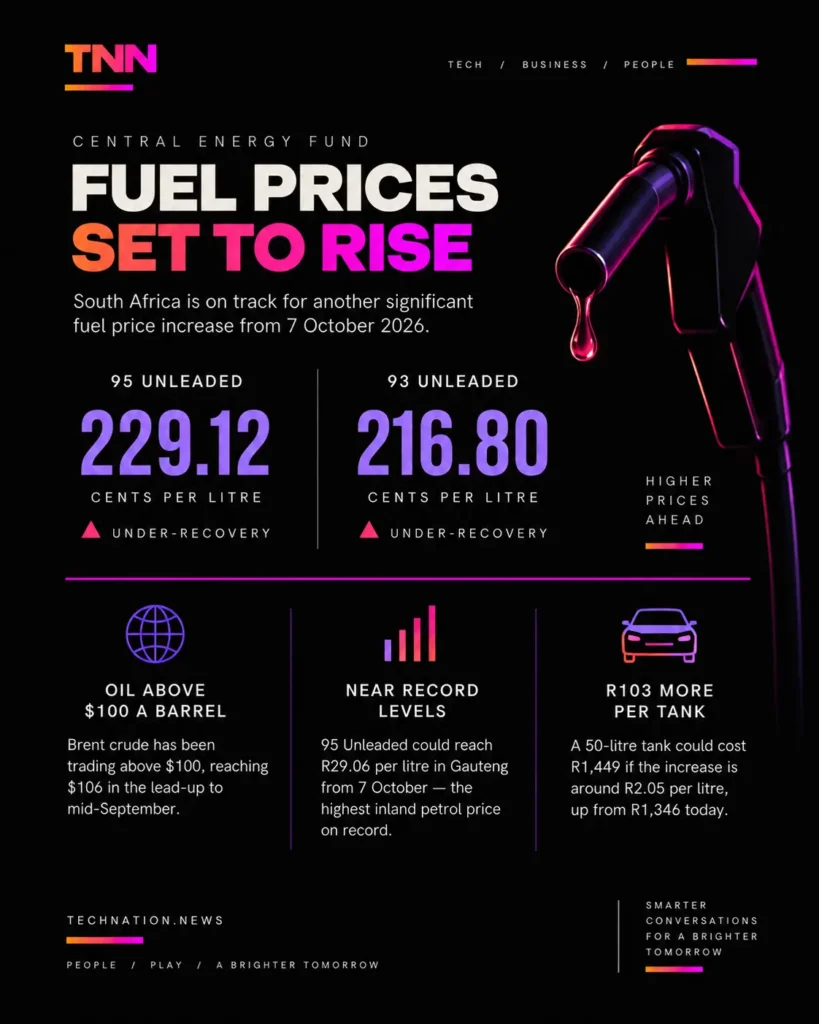
The Central Energy Fund’s (CEF) mid-cycle data for September 2026 shows an under-recovery of 229.12 cents per litre on 95 Unleaded petrol and 216.80 cents per litre on 93 Unleaded, meaning South Africa is on track for another significant fuel price increase from 7 October 2026.[1]
An under-recovery is the gap between what it costs to supply fuel at the current pump price and what it actually costs to procure and refine it. The bigger that gap, the larger the price adjustment needed to close it.
Fuel price forecast
The CEF snapshot dated 11 September 2026 puts the basic fuel price for 95 Unleaded at R17.93 per litre, against a press release contribution of only R14.15.
The resulting under-recovery of R3.78 a litre on that single day is the daily figure. The average under-recovery across the full tracking window of 28 August to 11 September is R2.29 for 95 petrol, and that average is what feeds into the official monthly adjustment.
For diesel, the picture is worse. The average under-recovery for 0.005% sulphur diesel runs to R2.22 a litre over the same window, while 0.05% sulphur diesel sits at R1.87. Illuminating paraffin clocks in at R2.39.
The CEF data unpacks the two main forces behind those under-recoveries. The movement in international product prices alone is responsible for R2.44 of the 95 petrol shortfall. The rand buying back 15 cents offsets a fraction of that, but not nearly enough.
Why oil is the problem
Brent crude has been trading above $100 a barrel and reached $106 in the days leading up to 14 September. The rand/dollar exchange rate at 11 September stood at R16.1585/$, and the daily rate has been drifting at the weaker end of its range throughout the tracking window.
The sustained oil price pressure traces to ongoing conflict in the Middle East West Asia and reduced petroleum output from Russia as a result of Ukrainian strikes on energy infrastructure.[2] Those supply disruptions have kept the global basket of petroleum products that feeds into South Africa’s basic fuel price calculation under pressure for months.
Where the pump prices are now
Fill a 50-litre tank with 95 petrol today and it costs R1,346. If the October adjustment comes in at roughly R2.05 per litre, that same fill costs R1,449, a difference of R103 in one month.
Current Gauteng pump and wholesale prices:
- 95 Unleaded petrol: R26.92 per litre
- 93 Unleaded and LRP: R26.76 per litre
- Diesel 0.05% sulphur (wholesale): R29.11 per litre
- Diesel 0.005% sulphur (wholesale): R29.56 per litre
- Illuminating paraffin (max retail): R27.05 per litre
Projected under-recoveries feeding the October adjustment:
- Illuminating paraffin: R2.39 per litre
- 95 Unleaded: R2.29 per litre
- 93 Unleaded: R2.17 per litre
- Diesel 0.005% sulphur: R2.22 per litre
- Diesel 0.05% sulphur: R1.87 per litre
ALSO READ: Fuel costs are draining your wallet. Here’s how to fight back
The record in reach
Should the under-recoveries hold at current levels through to the end of September, 95 Unleaded could reach R29.06 per litre in Gauteng from 7 October, which would be the highest inland petrol price on record. The previous record was R28.06 per litre, set in June 2026.
Diesel is heading for record territory too. The 0.005% sulphur wholesale price currently sits at R29.56, and the average under-recovery of 222 c/l points to a ceiling the market has not seen before.
The Department of Mineral and Petroleum Resources (DMPR) will confirm October’s official prices at the start of next month. The CEF data published to date are forecasts, not final figures. Prices can still shift before the calculation window closes.
The government has not indicated any tax relief. Finance Minister Enoch Godongwana has said the state cannot absorb the increases through the national budget without taking on additional borrowing.
Footnotes:
[1] Central Energy Fund (CEF), Daily Basic Fuel Price Snapshot, CEF Group, 11 September 2026.
[2] ‘West Asia’ is used instead of ‘Middle East’ to avoid the Eurocentric framing embedded in the latter term, which defines the region relative to Europe.