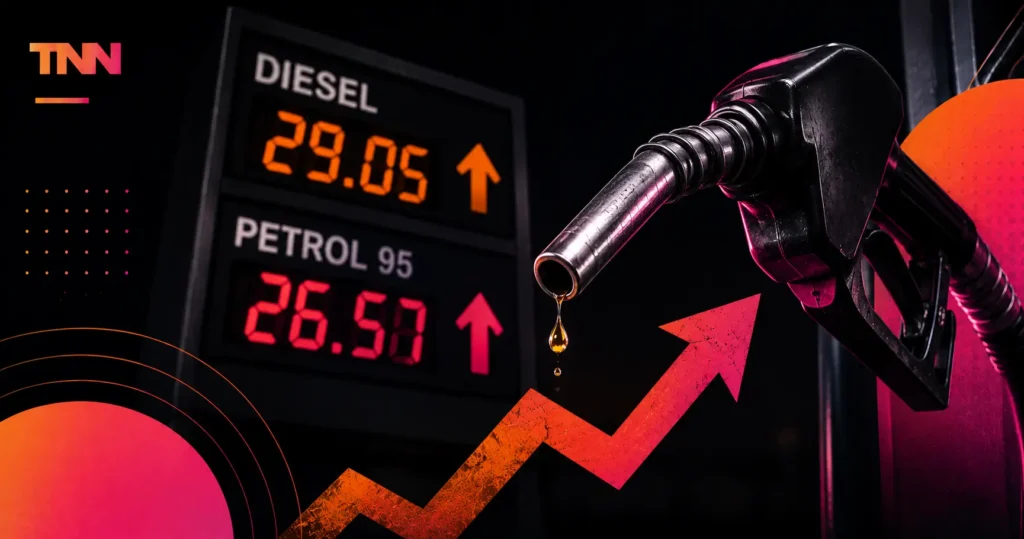

South Africa’s diesel prices climbed more than 11% from midnight on 2 September 2026, adding fresh pressure to freight, farming and logistics costs at a time when household budgets are already stretched thin. Petrol didn’t escape either.
According to Central Energy Fund (CEF) data, the Gauteng pump price for 95 unleaded petrol (ULP) is now 2 692.0 cents per litre, while 93 ULP and lead replacement petrol (LRP) sits at 2 676.0 cents per litre.
Diesel price hike
Diesel prices are a whole other story…. The wholesale price for 0.05% sulphur diesel is 2 911.11 cents per litre, and the 0.005% sulphur grade is 2 955.51 cents per litre.
What’s driving the increase
The CEF data shows just how sharply fuel costs have risen. For the period ending 2 September, petrol 95 had an under-recovery of 167.17 cents per litre, while petrol 93 was at 154.04 cents. Diesel was also well into under-recovery, at 139.23 cents per litre for 0.05% sulphur diesel and 143.72 cents for the 0.005% grade.
Across the full 28 August to 2 September review period, the average under-recovery was even higher, reaching 208.11 cents per litre for petrol 95 and 247.24 cents for 0.05% diesel. The main culprit was the jump in international fuel prices, while exchange-rate movements only provided a small offset.
In plain English: international fuel prices have shot up, pushing up the cost of bringing fuel into South Africa. The weaker rand has made things worse, although exchange-rate movements did offset a small part of the increase. The result is a much bigger gap between what fuel costs and what consumers were previously paying at the pump.
According to a Moneyweb report by Ciaran Ryan, Brent crude oil broke above $90 a barrel following fresh hostilities between the US and Iran, pushing diesel up an average 11.35% and petrol up 5.27% at midnight.
The report notes the increase pushed the wholesale price of 50ppm diesel back above R30 a litre, a level first breached in May 2026 when the price hit a record R31.38 after severe disruption to energy supplies through the Strait of Hormuz.
What it means at the pump
For diesel users, particularly in freight and agriculture, the compounding effect is real. South Africans are now paying three times more for diesel than a decade ago, according to Moneyweb’s reporting. Petrol consumers are paying more than 120% more than they did 10 years ago, against a 57% increase in consumer inflation over the same period.
“This increase in the price of fuel is yet another reminder of just how highly susceptible the industry is to the volatility of global oil markets,” said Gavin Kelly, CEO of the Road Freight Association, as quoted in the Moneyweb report.