
Anthropic dropped Claude Sonnet 5, and the gap between its mid-tier model and its flagship is now noticeably smaller.
The company is calling it the most agentic Sonnet yet, meaning it’s built to plan, use tools like browsers and terminals, and run through multi-step tasks with less hand-holding than its predecessors needed.
And it doesn’t come with the hefty Opus price tag either.
Claude Sonnet 5 launched
Sonnet models have historically been the budget-friendlier option compared to Anthropic’s top-tier Opus line. That gap is shrinking.
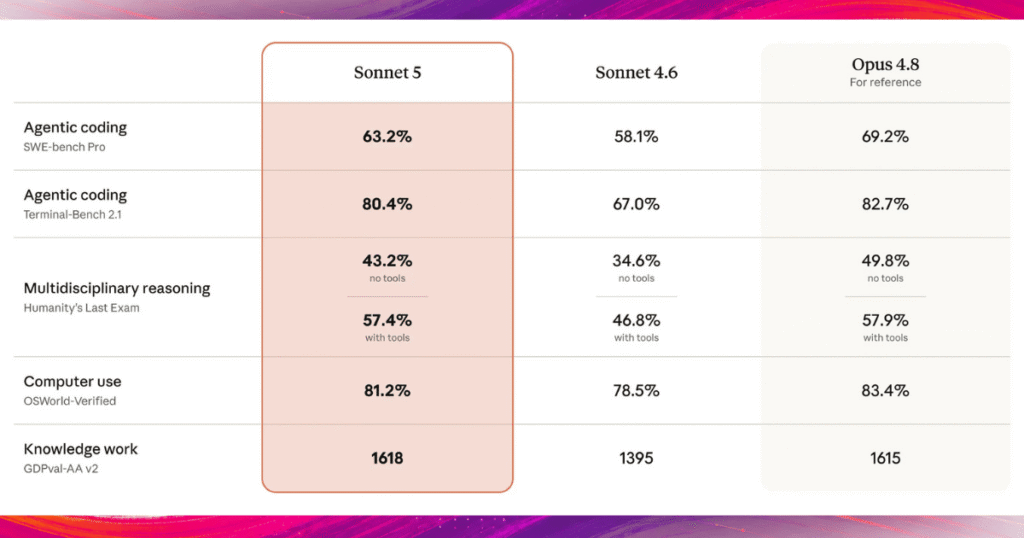
Antropic says Sonnet 5’s performance is close to that of Opus 4.8, but at lower prices. It’s also a real step up from its direct predecessor.
It is actually a substantial improvement over Sonnet 4.6 on important aspects of agentic performance like reasoning, tool use, coding, and knowledge work.
Case studies
Anthropic shared feedback from companies that had early access, and the theme across most of it was the same: Sonnet 5 finishes things instead of stalling halfway.
One example involved Salesforce updates and an enterprise email send running as a single job.
According to Daniel Shepard, Senior Engineer at Zapier: “We handed Claude Sonnet 5 a two-part job, update Salesforce account tiers, send a launch announcement to enterprise contacts, and it finished end to end. That used to stall halfway. For day-to-day automation, it’s a no-brainer.”
Another tester described a more unexpected moment. Neel Chotai, a Rust Engineer, explained: “I asked Claude Sonnet 5 to investigate a bug. Unprompted, it wrote a reproducing test, implemented the fix, then stashed it to confirm the bug came back without the change. All in a single pass.”
That’s the model checking its own work without being told to, which is a meaningfully different behaviour from earlier versions.
Safety guardrails
Anthropic ran its usual safety evaluations before release, and the results are mostly reassuring.
Sonnet 5 shows an overall lower rate of undesirable behaviors than Sonnet 4.6, and is generally safer to use in agentic contexts.
On the cybersecurity front specifically, the model’s capabilities remain limited by design.
Evaluations also show that it has a much lower ability to perform cybersecurity tasks than our current Opus models.
In tests involving Firefox browser exploits, Sonnet 5 was never able to develop a full working exploit, though it showed a slightly higher rate of partial success than its predecessor, something Anthropic attributes to general intelligence gains rather than any deliberate security training.
Pricing and availability
Sonnet 5 is now the default model for Free and Pro plans, and it’s also available on Max, Team, and Enterprise tiers, plus Claude Code and the Claude Platform.
Introductory pricing runs through 31 August 2026, at $2 per million input tokens and $10 per million output tokens.
After that, it moves to standard pricing of $3 per million input tokens and $15 per million output tokens. Developers can access it through the API using the model string claude-sonnet-5.