
Most South African companies running AI workloads right now are doing it on infrastructure they do not own, in jurisdictions they do not control, and under terms that can change at any time.
The AI compute your business depends on sits overwhelmingly in the United States, with a secondary but less advanced tier in Asia. South Africa has isolated pockets.
If access changes (or if pricing shifts, or if a regulatory decision in Washington or Brussels affects service terms), your operations feel it before your board does.
Europe noticed this problem at a continental level and decided to spend its way out of it.
What the EU actually announced
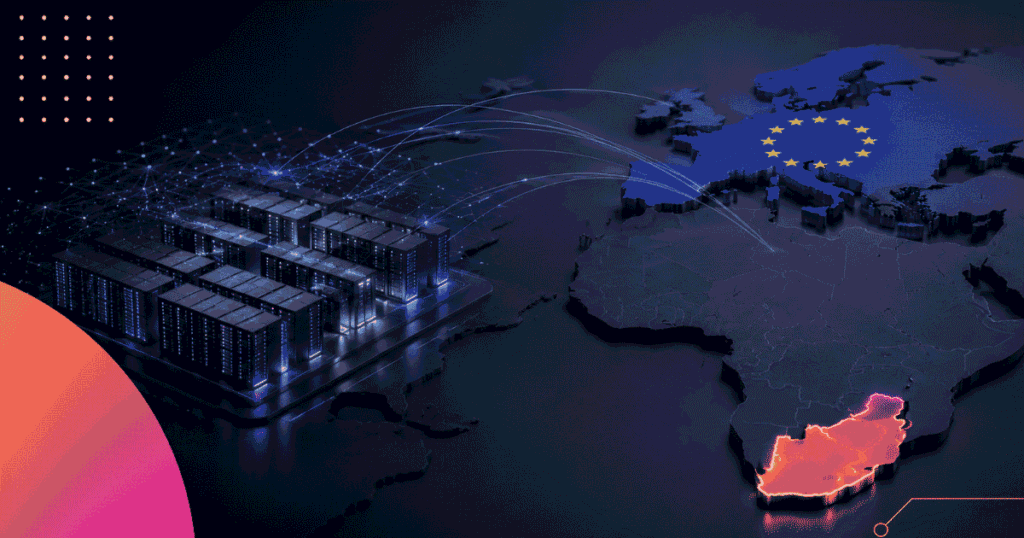
On 30 July 2026, the European Commission opened a call for tenders to build up to seven AI gigafactories across the bloc[1]. A gigafactory, in this context, is a large-scale data centre purpose-built to train and run frontier AI models, each designed to hold well over 100,000 advanced AI chips.
The initiative is backed by up to €10 billion (roughly R190 billion at the time of publishing) in EU and national government funding, structured to pull in at least €20 billion in private investment, bringing the total to more than €30 billion (R570 billion). Bids close 12 November 2026.
Awards are expected in early 2027, construction is targeted to start the same year, and the first facilities are aimed at being operational by mid-2028.
Applicants can be consortia of companies, investors, universities and public authorities, and sites may span more than one EU member state. The Commission frames the entire initiative around “technological sovereignty”: reducing European dependence on US and Chinese compute infrastructure.
Why this matters for SA boards
Francois van der Merwe, founder and MD of Johannesburg-based AI start-up Otinga.io, says, “Europe is not really buying compute here, it is buying sovereignty, […] a strategic asset decision rather than a return-on-investment one, and you should expect more countries to start making it on exactly those terms.”
“The uncomfortable part for a South African board is the principle underneath it, that whoever controls an asset your continuity depends on effectively controls you. […] Most enterprises are already far more dependent on AI than their own risk registers admit, so where your compute physically sits belongs in the business continuity assessment this year.”
Europe is treating compute infrastructure the way it treats energy supply or financial clearing: as a strategic dependency that warrants sovereign-level intervention. South African businesses are not European governments and cannot respond at that scale.
But the underlying logic applies at company level too. If a critical supplier can change your terms or restrict your access, that supplier belongs in your business continuity framework.
Most AI compute relationships in South Africa are not being assessed that way.
What this actually means to do about it
None of this requires abandoning cloud or foreign compute.
The unit economics of building sovereign infrastructure at company level make no sense for most South African businesses, and van der Merwe’s own quote acknowledges that every individual use case still has to clear its own numbers.
What it does require is honesty about what the risk register currently says versus what it should say.
- Which AI tools and services are operationally critical?
- Who controls the infrastructure they run on?
- What are the contractual terms around access, pricing and data jurisdiction?
- What is the contingency if those terms change?
Europe asked those questions at a continental level and arrived at a €30 billion answer. The questions are worth asking at company level before the answer is forced on you.
Sources
[1] European Commission, July 30, 2026.