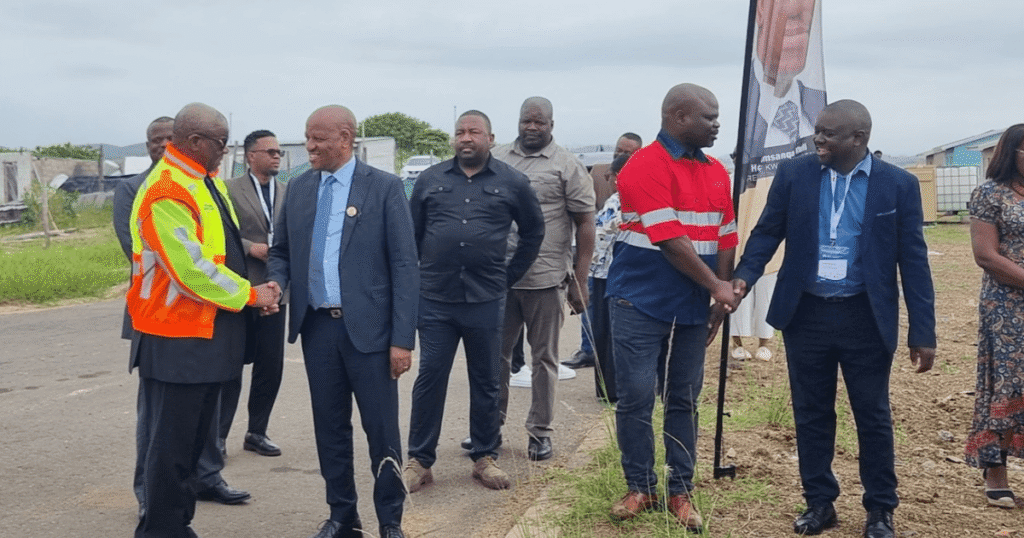

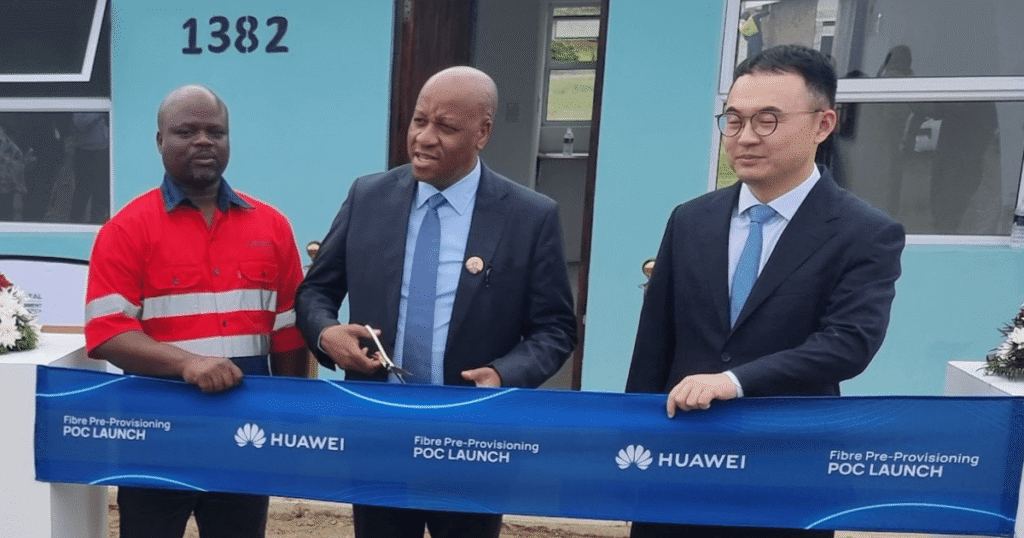
At 08:40 on Thursday morning, KwaZulu-Natal Premier Thamsanqa Ntuli cut a ribbon at a housing site in Empangeni, uMhlathuze. The houses behind him were still under construction and the roads were not yet finished.
In the homes, however, a small box was already installed. It is a connector point where a fibre cable will one day run back to an Openserve data centre roughly two kilometres away. The pipes that will carry that cable are already in the ground, laid alongside the water and electricity infrastructure before the concrete set.
It’s a pretty neat idea, when you think about it. Fibre goes in with the water and the electricity, not years later when someone has to dig up a finished road to get it there.
Why retrofitting is so expensive
The standard way of connecting a completed community to fibre involves applying for a wayleave, which means getting permission from the municipality to cut into the road. That process alone draws in the water authority and the electricity authority, because construction work on one pipe can damage another.
Once the wayleave is granted, the road gets trenched, the fibre goes in, and the road gets repaired. Li Yanbang, Huawei’s Solution Manager who presented the proof of concept, described it as costly in time and money on both counts.[1]
If the house is already built without a conduit, a technician also has to drill into finished walls to route a cable inside. That combination of factors is, in Li’s words, why FTTH is very costly for some communities in South Africa right now.
What is actually being built in Empangeni
The project is called the Fibre Pre-Provisioning Proof of Concept. It sits in Phase 1A of the Empangeni Mega Housing Project, in the uMhlathuze Local Municipality in KwaZulu-Natal.
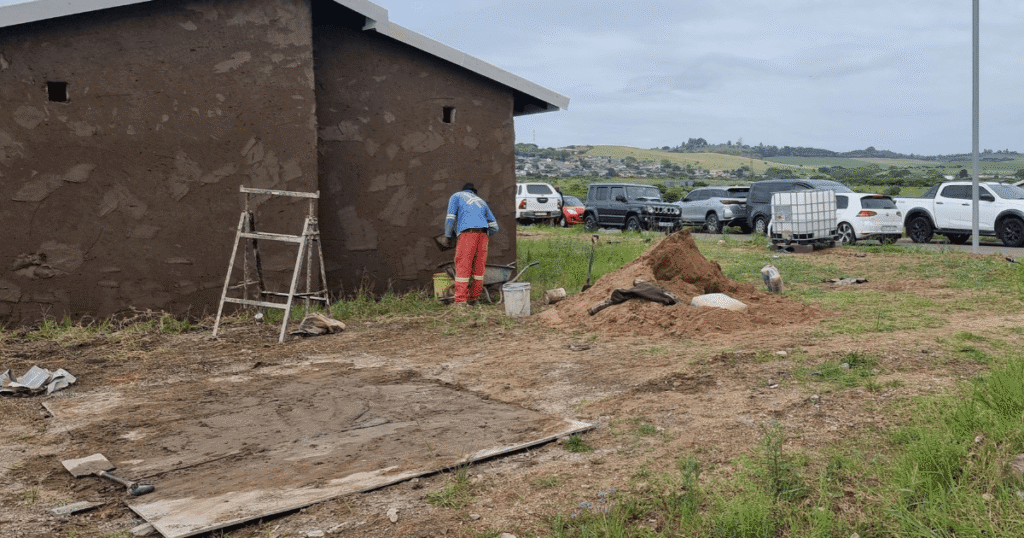
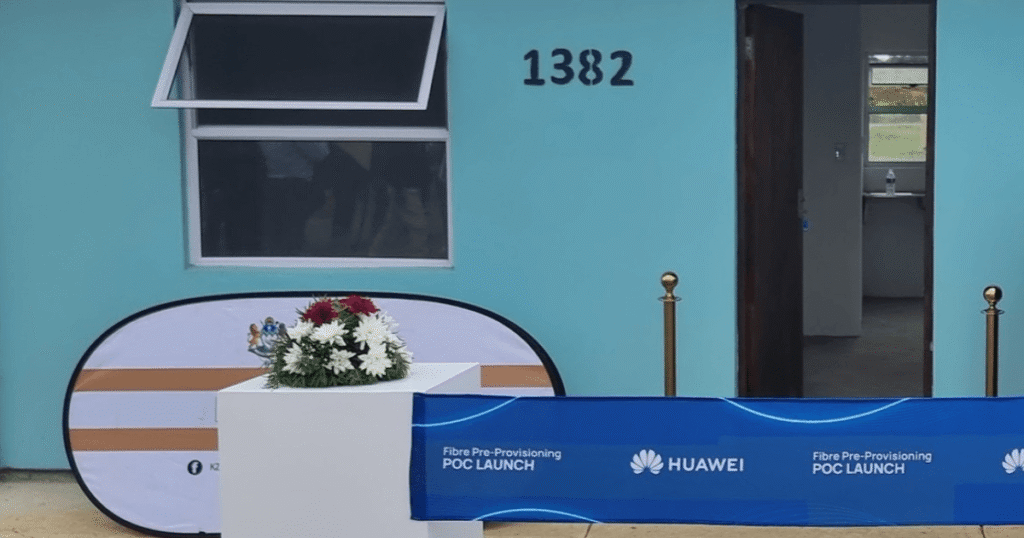
At this site, the conduit is laid underground during construction, running to each home. In the show unit, a small interface box sits in the open-plan lounge and kitchen area near the front door.
This is called the “pipe and box” approach. So, when a resident eventually wants internet, the fibre pathway to their home already exists and far less excavation is needed.
Phase 1A covers 405 houses within the wider Empangeni Mega Housing project, which is planned to deliver 10,065 units across three phases.[2] The POC will test whether fibre pre-provisioning works under real construction conditions at Phase 1A. Its findings will help establish whether, and how, the approach could be applied to other housing developments.
The POC does not itself provide fibre services. It establishes the physical infrastructure that will make future connectivity possible.
What this means for the families moving in
The barrier to connectivity is a cost issue and not necessarily due to poor signal or network coverage. Speaking at the launch, Mayor Xolani Ngwezi of uMhlathuze said many residents in townships and rural areas are excluded from the digital economy because data costs too much[3].
This was backed up by Pearl Schrimpton, Openserve’s Executive: Enterprise and Public Sector who said too many households depend on small data bundles that run out halfway through the month, often at the moment when they are needed most[4].
A fixed line into a house, with a choice of service providers and packages, can change how a family connects online every day. That is the difference between a prepaid data bundle counting down and a monthly subscription that does not watch the clock.
READ: KZN Government, Openserve and Huawei partner to pioneer fibre-ready housing
The money question
Building fibre into a housing development from the start, rather than retrofitting it later, could significantly reduce deployment costs. Li said fibre pre-provisioning could cut those costs by 50% by avoiding duplicate investment in fibre infrastructure.
“With fibre already in place, deployment will not damage existing infrastructure, and that will give houses a longer life cycle,” Li said. He also stressed the benefits for residents, saying everyone in South Africa should have the opportunity to access fibre.
At the time of publishing, the full cost to households could not yet be established. The cost of installing the infrastructure is only the first step. Connection fees for families in Phase 1A, along with the ISP packages that will be available and their prices, are still to be determined.
Openserve’s open-access model could give residents more choice. Schrimpton explained that Openserve, part of Telkom Group, allows licensed internet service providers to offer services over its infrastructure.[4] This means residents can choose between providers where services are available.
Schrimpton said the open-access model allows licensed ISPs to offer services over Openserve’s infrastructure. The extent of choice available to residents will depend on which providers offer packages at the development and what those packages cost.
Three questions that will decide if it worked
Shrimpton said the proof of concept has three questions to answer over the coming months:
- First: does it work in the real conditions of a living building site, with the construction team and the infrastructure builders working side by side?
- Second: what does it actually save?
- The time and cost of building fibre in from the start will be compared directly against the cost of the old way, measured on site, not estimated.
- Third and most importantly: can it be repeated?
A pilot that works once is not much use to anyone. But when it leaves a model that any housing developer, municipality or network operator can pick up and use, now that’s useful.
Schrimpton said results will go to the National Department of Human Settlements to support its review of the norms and standards that govern how housing is planned and built in South Africa. The review provides an opportunity for the findings to inform the discussion.
The partners behind the project
The PoC brings together the KwaZulu-Natal Provincial Government, the KZN Department of Human Settlements, uMhlathuze Local Municipality, Huawei and Openserve. And each has a specific role.
- The province provides leadership and strategic oversight.
- The Department of Human Settlements contributes expertise in settlement planning.
- The municipality handles local coordination and approvals.
- Huawei provides technical advice and knowledge transfer.
- Openserve contributes telecommunications infrastructure and future connectivity planning.
Rendani Musetha, Chief Director: Digital Government at the Department of Communications and Digital Technologies (DCDT), asked: “Why should we build houses today and only think about connectivity tomorrow?”[5]
Lindani Khoza, Chief Director at the KZN Department of Human Settlements, said this project is “a new way of thinking about infrastructure delivery, integrating connectivity into the earlier stages of planning rather than treating it as an afterthought.”[6]
Ntuli said no one in KwaZulu-Natal should feel excluded from the opportunities available to the rest of the country.[7]
What is still unanswered
Several things were not settled on the day.
For example, when residents will move into the Phase 1A houses. The site is still under construction.
When fibre services will become available after residents move in was also not confirmed. The cost to the household of connecting to the line was not addressed either, but it was noted that this discussion should take place.
How the measurement results will be published, and on what timeline, was not specified. Schrimpton said they will go to the National Department of Human Settlements, but no date or format has been finalised (as this is still an ongoing project).
How secure the installations are. A box fitted into a wall before anyone lives in the house, on a site where construction is still ongoing, is exposed. Mayor Ngwezi urged residents to protect the infrastructure from theft and vandalism and asked for further discussions on infrastructure challenges in the city.[3]
Back to the family and the keys
Every year, the state builds thousands of homes for South African families. If connectivity infrastructure is included from the start, new housing settlements can be better prepared for fibre services when residents move in.
The ribbon was cut on Thursday morning. Now the work begins. The results will show whether fibre pre-provisioning can save time and money, and whether the findings lead to changes in national housing standards.
Sources
[1] Li Yanbang (Solution Manager, Huawei). Speech, KwaZulu-Natal, Oct. 22, 2026. Audio recordings and transcripts for [1][3][4][5][6][7] by the author. Stored locally, unpublished.
[2] KwaZulu-Natal Department of Human Settlements. Detailed Empangeni IRDP Mega Project Status Report [pdf], 21 July 2026. Speech.
[3] Ngwezi, Xolani (Mayor, uMhlathuze Local Municipality). Speech.
[4] Schrimpton, Pearl (Executive Enterprise and Public Sector, Openserve). Speech.
[5] Musetha, Rendani (Chief Director: Digital Government, Department of Communications and Digital Technologies). Speech.
[6] Khoza, Lindani (Chief Director, KZN Department of Human Settlements). Speech.
[7] Ntuli, Thamsanqa (Premier of KwaZulu-Natal). Keynote speech.