
Africa Day 2026 brought together governance experts, development practitioners, and youth leaders for a webinar on one of the continent’s most pressing challenges: Africa’s water crisis.
Water governance in Africa is as much a development and equity issue as it is an environmental issue. The message from the panel was clear.
This article is based on a presentation by Kudakwashe Watetepa at the Securing Water, Ensuring Sanitation, and Advancing Inclusive and Sustainable Development webinar, hosted on 26 May 2026.
Africa Day commemoration webinar
The dialogue, aligned with the African Union’s 2026 Theme of the Year and Agenda 2063, focused on securing water, ensuring sanitation, and advancing inclusive and sustainable development across Africa.
The panel included Dr Nkosana Donald Moyo, founder of the Mandela Institute for Development Studies (MINDS) and former vice president and COO of the African Development Bank Group.
Joining him were Dr Elijah Masubelele, deputy executive director at the Institute for Justice and Reconciliation, Kudakwashe Watetepa, a youth in agribusiness expert, Dr Keratiloe Mogotsi, associate dean at Chatham University in Pennsylvania, and Gracious Nyathi, a youth development and communication practitioner representing MINDS Africa.
Africa’s water challenges
The challenge in Africa is water scarcity, sure, but other challenges we cannot overlook include who makes the decisions and who benefits from them, and who gets left out of the conversation entirely.
Agriculture accounts for between 70% and 80% of all freshwater withdrawals on the continent.[1] But only 6% of cultivated land in Sub-Saharan Africa is currently irrigated. This shows exactly where governance has fallen short.[2]
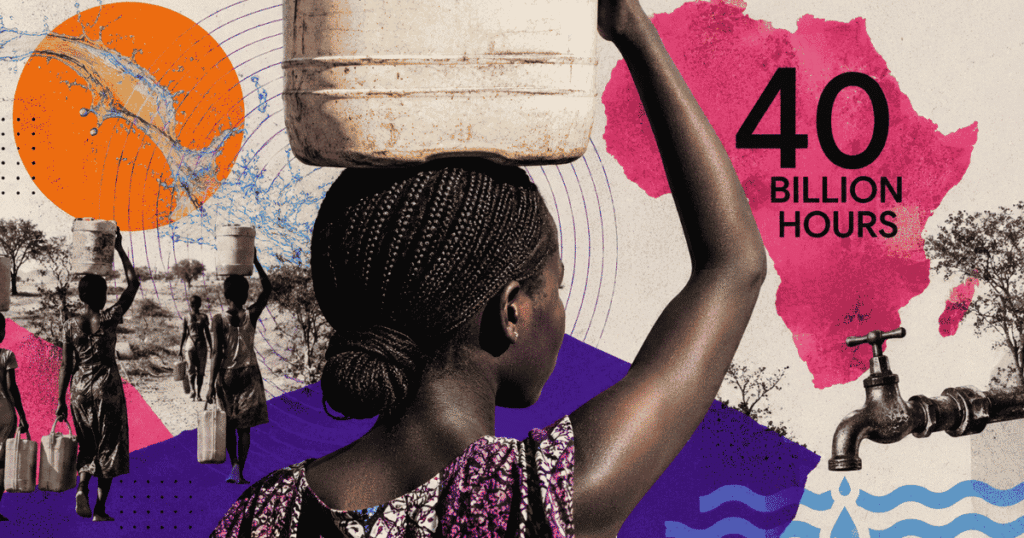
Kudakwashe Watetepa in his presentation highlighted how women and girls bear the most visible cost.
They collectively spend 40 billion hours every year fetching water (from research done a decade ago)[3]. Time that could have been spent attending school, building businesses, participating in the economy, building communities.
The food system is directly at risk
95% of agriculture in Sub-Saharan Africa is rain-fed.[4] That means it is entirely dependent on climate patterns, with absolutely no buffer when those patterns shift.
Climate change is already disrupting crops, livestock, and fisheries across the region. The El Niño droughts that hit Southern Africa between 2024 and 2025 were a sharp reminder of how quickly things can collapse.
We might assume water security and food security are separate problems, but they are not. One determines the other, and weak governance makes both worse.
Rural communities are being let down
Many rural water points fail, and technology is not always to blame for these failures. Rural water points also fail because of weak maintenance and poor accountability structures.
At the moment, transparent budgeting and performance monitoring are treated as optional extras. This should change, because they are what keeps water flowing to the people who need it most.
When those systems are absent, rural communities pay the price through unreliable infrastructure and deepening inequality.
Anti-corruption measures play a direct role here too. Public trust in water systems depends on them.
Young people should be at the table
Youth represent over 60% of Africa’s population. That is an enormous resource that water governance has largely failed to include.
When young people, women and marginalised communities participate in governance decisions, the outcomes improve drastically. Community-led systems are consistently more sustainable than top-down ones.
Why? Because participation builds ownership and ownership builds accountability.
Water, food, energy: You cannot manage them separately
The Water-Energy-Food-Ecosystems Nexus is as much a practical operating reality as it is a policy framework. These systems are deeply connected, and managing one without considering the others creates gaps that compound quickly.
Cross-border river basin management, coordination between urban growth and agricultural demand, and integrated planning across sectors are all part of what good governance looks like in practice.
Urbanisation and agricultural expansion are happening simultaneously across the continent. Coordination between them has become essential, because without it, the pressure on water systems will only grow.
Africa already has answers worth scaling
Several countries are already demonstrating what is possible with the right governance in place.
Namibia has pioneered potable water reclamation from wastewater, a model that is drawing global attention. Kenya has youth-led agritech initiatives using solar irrigation to support smallholder farmers. Rwanda’s sanitation programmes have delivered measurable improvements in rural health outcomes.
Botswana continues to invest in drought resilience, and the Southern African Development Community is advancing transboundary river basin management across the region. Institutions like AMCOW, AUDA-NEPAD, and CCARDESA are supporting these efforts at a continental scale.
The innovation is already here. The question is whether it gets the policy support to grow.
What needs to happen next
Climate-resilient water infrastructure is where investment needs to go first.
Once we get that right, sustainable irrigation expansion follows naturally from there, given that only 6% of cultivated land is currently irrigated.
The solution?
- Women and youth need meaningful roles in water governance, with real decision-making power.
- Accountability mechanisms need to be strengthened, and that work happens on the ground as much as it does in policy documents drawn up in airconned boardrooms.
- Community-led solutions need funding and the regulatory environment to scale.
Africa’s water future is not determined yet. Every governance decision made now shapes what the continent looks like in 20 years.
Citations:
[1] O. V. Obayomi, R. Attah, S. S. Sayem, et al. (March 2026). Sustainable agriculture in the face of water scarcity: Opportunities, challenges, and global perspectives. Science Direct.
[2] C. H. Ebeke, M. N. Etoundi (Dec 2025). Crop Productivity in Sub-Saharan Africa: The Role of Research and Development. eISBN: 9798229026567. IMF eLibrary.
[3] UN Women. (March 2014). Collecting and carrying water, burdensome reality for women. UN Women.
[4] J. Nash, (2013). Unlocking Africa’s Agricultural Potential: An Action Agenda for Transformation. report. The World Bank.