
If you were hoping for a more convenient moment to start your AI journey, Salesforce has some bad news: that moment has already passed.
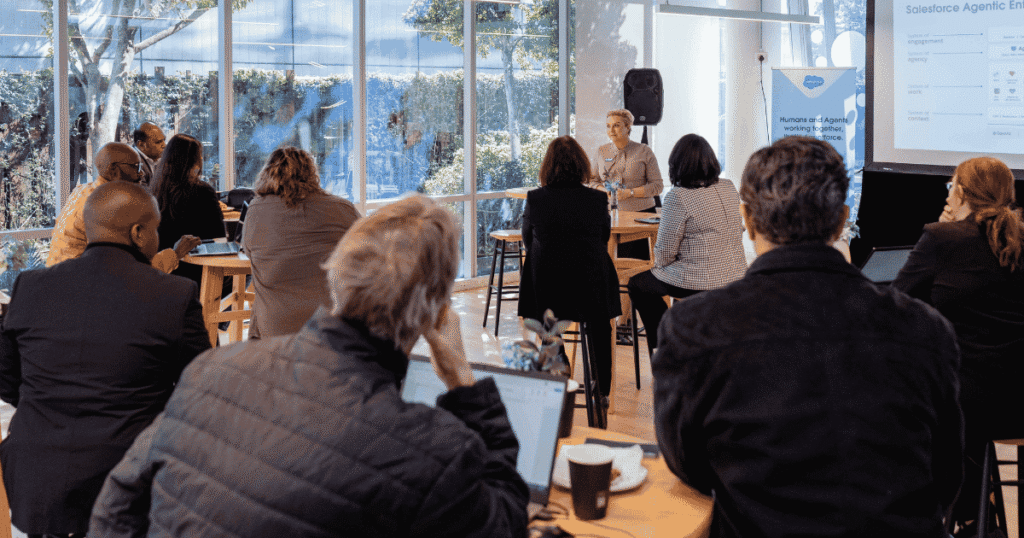
That was the collective message from a media roundtable held at WeWork Oxford Road in Rosebank on 12 May, where senior Salesforce leaders and a change practitioner from Standard Bank Group sat down for what can only be described as a frank intervention.
The conversation covered localisation, skills, workforce design, and leadership accountability. But the thread running through all of it was urgency.
Africa’s AI opportunity
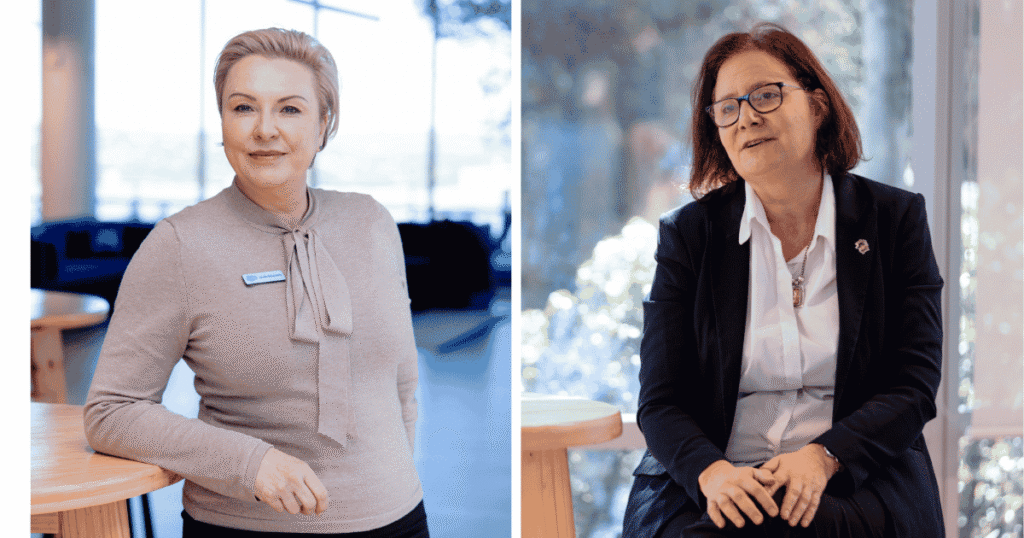
Linda Saunders, Country Manager and Senior Director of Solution Engineering Africa at Salesforce, opened by grounding the discussion in something very specific to this continent.
Foundational AI models are built primarily on internet data and western sources, meaning Africa’s languages and cultures are significantly underrepresented.
The real opportunity for local organisations, she explained, is not in the foundation model itself but in the layer above it: using your own organisational data and values to make AI work for your specific context.
The risk of getting it wrong is real too. Saunders gave an example of AI washing: an eco-friendly shoe company announced it was buying GPUs to rent out, and its share price jumped roughly 600% in a single day.
The company later walked it back. The word AI, attached to almost anything, still moves markets. That says as much about hype as it does about genuine transformation.
AI for productivity
Platforms like Slack are sitting on a wealth of organisational intelligence that most businesses have barely touched (or even thought about). Most companies are sitting on years of searchable, structured conversation and treating it like a chat log.
This made sense to me, a person who has used Slack across multiple newsrooms and organisations, and who built a personal Slack server just to have somewhere to catch ideas and set reminders for myself.
Saunders also shared what AI-driven transformation looks like in her own day. Three years ago, she started each morning scanning hundreds (and sometimes thousands) of emails.
Today, AI and Slackbot surfaces what matters most for her day. “I have redesigned my entire job. I was given access to tools, the freedom to fail forward, and the encouragement to discuss the failures and the successes. In that ecosystem, I redesigned everything. I have time not only to do great work, but I actually have time to be human,” she said.
This personal experience is a proof of concept for what becomes possible at scale when AI is implemented as genuine augmentation.
The skills gap is a problem
Ursula Fear, Senior Talent Programme Manager at Salesforce, brought the conversation down to a number that should make any HR leader uncomfortable. AI curricula are evolving on four-month cycles. South Africa’s formal qualification frameworks run on five-year timelines. That gap is not a future problem.
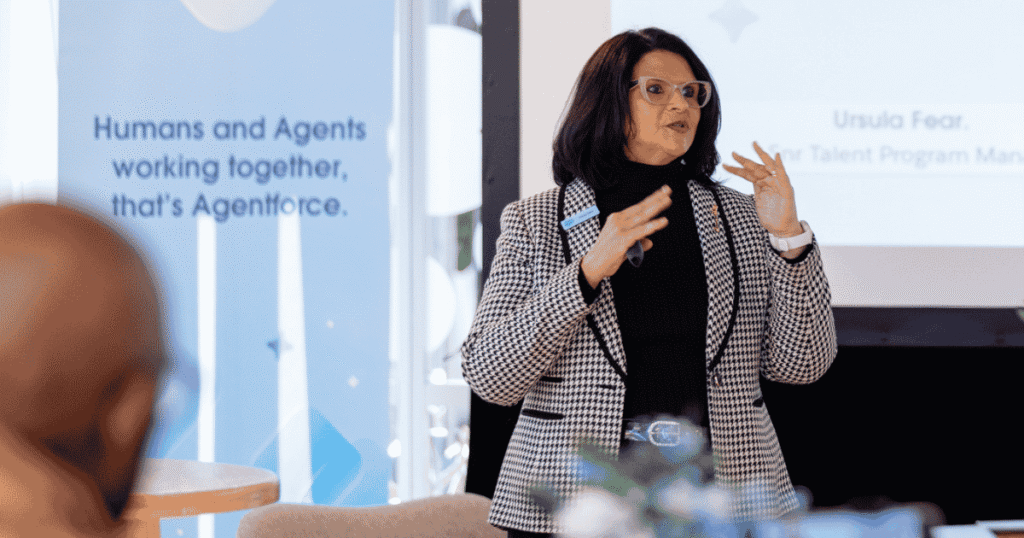
Fear’s argument: learning has to move into the flow of work itself. Professionals need to commit five to ten hours a week to staying current, and free platforms like Salesforce’s Trailhead are making that more accessible than ever.
She said the sweet spot is “genuine human-agent collaboration.” Give repetitive tasks to AI so humans can be free to do what they do best. “You have to build toward it deliberately, through continuous learning embedded in the work itself,” she said.
She also called for a redesign of job architecture, away from fixed descriptions and static roles, toward flexible workflows that reward adaptability. Young AI natives entering the workforce are an asset, she noted. The challenge is building environments that can actually absorb them.
What enterprise adoption really looks like
Heidi Levy, Change Lead for the Salesforce Programme at Standard Bank Group, delivered the session’s most operationally grounded perspective.
It is this: leadership commitment cannot be delegated.
Executives who don’t visibly use AI tools send a clear signal that transformation is optional, when it’s really not. The key to unlocking adoption comes down to one question every employee is quietly asking.
“Adoption is driven by one question: what is in it for me? When employees experience, directly, that AI removes the parts of their job they like least and gives them back time for meaningful work, resistance dissolves. You stop pushing and the organisation starts pulling,” she said.
Standard Bank’s approach was structured around what Heidi calls the LEVERS framework:
- Leadership,
- Ecosystem,
- Values,
- Enablement, and
- Structure.
It sounds corporate until you hear what it looked like in practice:
- a CEO doing Trailhead training on Sundays,
- 700 embedded change agents across the business,
- annual storytelling festivals where employees presented their AI journeys in songs, videos, and live performances.
Standard Bank even appointed a Chief Storytelling Officer.
Levy also emphasised the importance of accountability. As AI embeds itself in operational decision-making, board-level ownership is non-negotiable. And individual responsibility matters just as much. Employees need to understand both the power and the risks of the tools they’re using.
Organisations that move fast and bring every layer of their workforce along will sustain their gains. The organisations that move fast and leave people behind won’t scale and won’t see those gains.
Those still waiting for the right moment, as Saunders put it, are already behind.