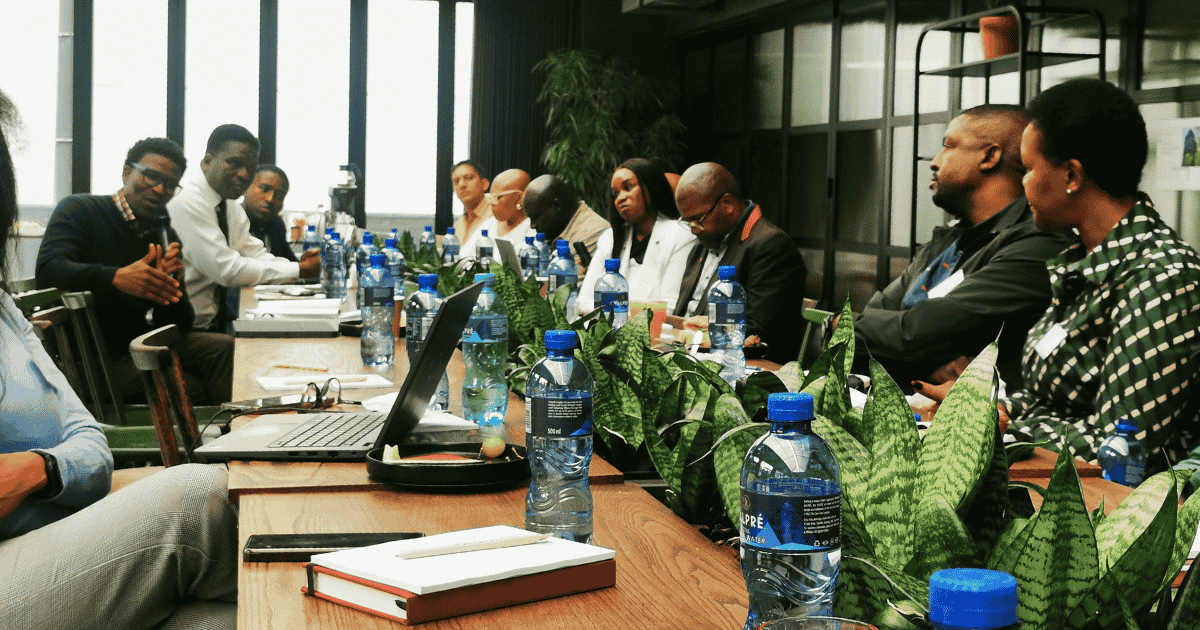

On 5 March, stakeholders gathered in Rosebank for the Digital News Transformation Fund’s national roundtable. This was a working session, with panel explanations up front and blunt feedback from the floor after.
The roundtable happened against the backdrop of South Africa’s Competition Commission inquiry into digital platforms.[1]
The fund’s origin story is not subtle.
What the DNTF is, and how it works
As reiterated by media consultant Izak Minnaar in the opening remarks, the DNTF is a voluntary alternative to looming platform regulation pressure.
Minnaar said Google (represented in the room by Marianne Erasmus) began discussions with industry bodies, first through Public Support Services (PSS) and later with the Association of Independent Publishers (AIP).
The pitch was investment that could benefit bigger publishers and smaller publishers, without Google directly deciding who gets funded.
The DNTF is designed so that Google funds, but does not allocate. An independent structure distributes money, with oversight and separation built in.
The board provides governance, while an adjudication committee assesses projects. The board then ratifies process compliance, without getting involved in the merits of individual applications.
How the DNTF assesses applications
Leanne Kunz, representing Tshikululu Social Investments, described the application pipeline in plain operational terms:
- Eligibility checks come first, including registration and tax compliance.
- Only after that does the adjudication committee assess the project itself.
- This is done using a scoring matrix that looks at
- feasibility,
- impact,
- capacity, and alignment with fund objectives.
- Projects are then scored red, amber, or green.
- Recommendations go to the board for ratification.
From there, it moves into contracting and delivery.
Each grantee gets a grant agreement that is not copy-paste, and each agreement includes project-specific objectives and KPIs built with the grantee.
Monitoring and evaluation follows, alongside training and capacity building through approved trainers.
The detail matters because the criticism in the room was the process and the outcomes do not land evenly across the sector.
First round hurdles
There were “hiccups” in the first funding round. Minnaar said a second round had just wrapped, with far fewer complaints and a stronger process.
The DNTF also has a formal obligation to consult with the industry at least annually, and that consultation is meant to shape priorities for the next year’s calls. This roundtable was positioned as part of that requirement.
Sebenzile Nkambule, a DNTF board member, framed the fund’s early work through three pressure points.
She emphasised governance and accountability first, and then focused on conflict-of-interest management and explained why the sector’s small size makes “zero association” standards unrealistic.
Her point was that the solution is a declared, managed approach, and a hard boundary between board oversight and adjudication decisions.
Nkambule’s second theme was mission alignment. She acknowledged the anger of community and niche publishers who feel left behind, and she said the pot is limited relative to demand.
Her third theme was process, and she argued the fund has tried to respond openly when problems surfaced, including conducting an audit of the process itself.
This is also where the Ignite tier comes in. Nkambule described Ignite as a structural response to smaller publishers being excluded based on criteria and capacity, not because of personal preference.
Practical proposal: Helping publishers
One of the strongest ideas on the day came from Press Council executive director Phathiswa Magopeni. She raised the option of clustering smaller publishers by language and region into shared portals with syndicated content.
Smaller publishers struggle for traffic and the technical hurdles of managing a website. They are also less interesting to advertisers without scale.
“Is it something you would consider, to cluster [publishers] by region and language and set up online sites? […] They would share a site instead of each one setting up their own, because […] they are not going to have traffic [and] they are not going to be able to [be] marketed.”[2a]
The response from the panel was agreement in principle. It was explicitly linked to Ignite, and framed as the right moment to talk about alliances and co-publishing.
Board co-chair Vincent Maher, CEO of Broadbrand, underlined the advertising reality with a line that should be printed on a poster:
“You can’t go to them with 40 individual deals of R10,000 each. You have to aggregate and put it all together.”[2b]
If the DNTF wants to fund sustainability rather than activity, this is where the focus should be.
Where the room got heated
A representative of the Black Media Owners Association (BMOA) challenged the fund’s public visibility.
He said many publishers still don’t know who benefited, and that social media communication can feel generic and corporate-coded.
Governance and communication
The fund’s response returned to structure and channels. Speakers reiterated the governance layers, including the separation between adjudication and the board, and conflict-of-interest rules that require recusal.
They also said awardees are listed on the DNTF website, and argued that direct communication through sector bodies matters because Press Council membership is part of eligibility.
Privacy for grantees
Lebo Madiba, founder of PR Powerhouse, said the fund does announce grantees, but that public interest coverage is harder to secure than people assume. Madiba added that the fund has tried profiling grantees, but some smaller publications are reluctant because they don’t want it widely known they have ‘money in the bank’.[2c]
Then Shoeshoe Qhu, CEO of the Media Development and Diversity Agency (MDDA), put the risk on record.
“Community media and small commercial media publishers have actually complained to Parliament about how the fund is run,” she said, adding that Google should expect to hear from Parliament.[2d]
Transparency
Qhu argued that transparency and perceptions of subjectivity are now at the heart of the issue. She said posting on social media is not the same as “speaking with the stakeholders,” and it is insufficient given the sector’s expectation of meaningful engagement.
“I think we could also look at other ways in how we can intervene in providing capacity building initiatives to help publishers to manage their businesses as businesses and understand their fiduciary duties. I want to say this to the media association leaders who are here [BMOA, AIP, ACM], you have a responsibility and duty to educate your members that they are the ones running the business.”[2e]
Financial literacy
She also pushed back on the idea that compliance requirements should be relaxed for struggling publishers. Applicants must still meet the funder’s conditions, even when funding is received from a grant. This includes financial documentation.
Where financial literacy is a barrier, her view was that the sector needs capacity building, and that industry bodies have a duty to educate members because they are running businesses, not hobby projects.
My view from the room
As a new, small publisher, I left thinking the DNTF is doing something difficult with a serious attempt at governance. I also left thinking the money is only half the story.
The other half is credibility (especially in a sector primed for suspicion).
The fund needs communication that explains actions and eligibility in plain language, and that reaches publishers where they actually are – without assuming they already live inside industry structures.
Sources:
[1] Reuters. “South African media get funding package from Google after antitrust probe.” 13 November 2025.
[2] TechNation News. “Digital News Transformation Fund National Stakeholder Roundtable, Johannesburg, 5 March 2026: author recording and transcript.”
[2a] Timestamp 14:39–15:07.
[2b] Timestamp 18:20–18:30.
[2c] Timestamp 38:42–39:37.
[2d] Timestamp 52:48–53:03.
[2e] Timestamp 58:08–58:50.
The use of AI:
I used AI to transcribe audio from the DNTF stakeholder roundtable, and to generate an initial draft from the scribbles in my actual notebook and transcripts. I reviewed the transcript against the recording for names and context, then rewrote and edited the article for accuracy, clarity, and attribution.