
Are we overlooking how women actually enter tech careers?
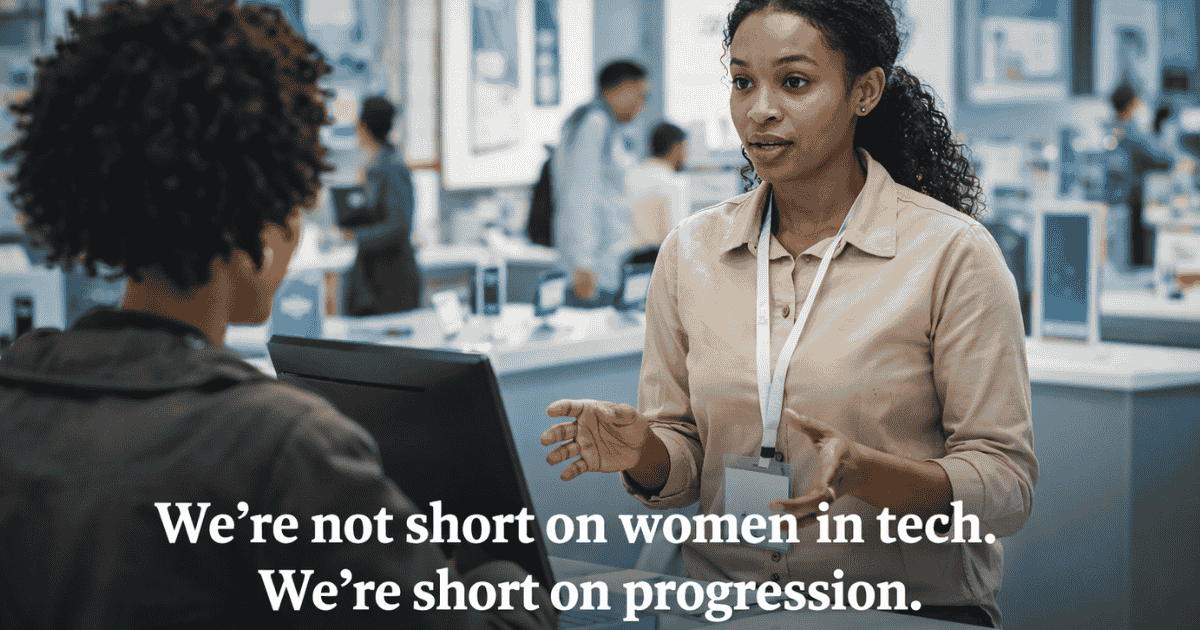
Walk into any phone store on a Saturday, and you see the most honest version of South Africa’s tech economy. Customers arrive with practical problems from a device that must last, a camera that must work, a phone that has to carry a small business, schoolwork, banking, and daily coordination.
The person across the counter becomes the translator between capability and real life. That translation work is not secondary, it determines whether the technology lands or fails.
Mobile-first describes career entry
South Africa is widely described as a mobile-first economy, with more than 90% of internet users accessing the internet via mobile devices.
In a country where mobile is the dominant interface, consumer technology sits close to everyday participation, and it creates one of the largest entry ramps into the tech career sector itself.
Retail, field operations, training, customer enablement, marketing, and analytics are not “adjacent” to tech. They are the commercial and human infrastructure which makes technology usable.
The pipeline exists but we need progression
Even with such a wide entry ramp, women’s tech careers still narrow as seniority rises.
The pattern is familiar across the sector: women are present in frontline and mid-level roles, yet thinner at higher levels. Entry is not the hard part…. Progression is.
South Africa’s employment equity data reflects a familiar pattern, women are present in the workforce and concentrated at lower occupational levels, and representation narrows as seniority rises.
The Commission for Employment Equity’s latest annual report shows women at 26.2% of top management in the private sector, and 38.3% of senior management; still well below parity. The figures demonstrate that while the pipeline exists, entry is not the hard part. It’s progression.
The IWD 2026 test: outcomes, not sentiment
International Women’s Day 2026 (observed on Sunday, 8 March) set the right standard because it is not sentimental. UN Women’s theme Rights. Justice. Action. For ALL Women and Girls is a demand for outcomes.
In workplace terms, it asks:
- whether women have access to real growth pathways,
- whether performance and potential are assessed consistently enough to be fair, and
- whether mobility into authority roles happens at a rate that changes who holds decision-making power.
Where consumer tech gets it right
Consumer tech can answer that test more credibly than many sectors because the leadership ladder is already built into the operating model. The question is whether companies treat that ladder as a pipeline (deliberate, visible, and supported), or leave it to chance.
A viable pathway can start on the shop floor and lead to roles with real accountability. Frontline talent often moves into specialist and training roles because they can translate technology into value and lift team capability.
From there, leadership becomes operational: coaching, targets, performance rhythms, customer experience, and the discipline of execution.
Parallel pathways
With the right support, that grows into field leadership, area and regional responsibility, where commercial delivery and team culture sit on your shoulders. Parallel pathways exist in analytics and planning, where people move from reporting into decision support and strategy because they understand market signals and operational realities.
The difference between a pathway and a holding pattern is that a pathway is designed as a system with clear expectations, a coaching cadence, practical management training for first-line leaders, and commercial literacy that aligns with the responsibilities people are already carrying.
The real shift is not to measure progress by celebration or headcount, but by whether women’s careers actually advance.
STEM matters, but entry is not the same
STEM remains essential because it builds the technical depth that powers the next decade, from engineering and cybersecurity to data and advanced networks.
Entry, however, does not arrive in one uniform way.
For many women, it begins with proximity to the market in the form of a frontline role, a training function, field operations, or an entrepreneurial hustle built on mobile. These routes build different kinds of fluency, such as customer fluency, commercial fluency, operational fluency, and, for those who choose it, technical fluency over time.
The leadership question SA has to answer
The leadership question is whether the industry is building enough on-ramps and enough depth for those routes to lead somewhere real.
That means visible progression, deliberate sponsorship, and stretch responsibility that develops judgment. It also means decision-making space that women can enter and influence, thereby shaping outcomes with a broader range of experience and expertise.
A tech economy that drives development is built by talent that can rise, specialise, and lead.
When women move through multiple pathways into influence, the sector gains stronger leadership, sharper choices, and more durable growth.